Arthur Ganson is a kinetic sculptor. He makes mechanical art demonstrations and Rube Goldberg machines with existential themes. His moving sculptures have been exhibited at a number of science museums and art galleries. Ganson's work appeals to viewers of all ages, and has been featured in an animated children's television show. He has invented mass-produced children's toys, and hosts an annual competition to make Rube Goldberg chain reaction machines.
Machine with Concrete. The gear reductions mean the final gear will make one revolution in over 2 trillion years. The machine runs uninterrupted even though the final gear is embedded in concrete, and cannot rotate.
Kinetic art is art from any medium that contains movement perceivable by the viewer or that depends on motion for its effects. Canvas paintings that extend the viewer's perspective of the artwork and incorporate multidimensional movement are the earliest examples of kinetic art. More pertinently speaking, kinetic art is a term that today most often refers to three-dimensional sculptures and figures such as mobiles that move naturally or are machine operated. The moving parts are generally powered by wind, a motor or the observer. Kinetic art encompasses a wide variety of overlapping techniques and styles.
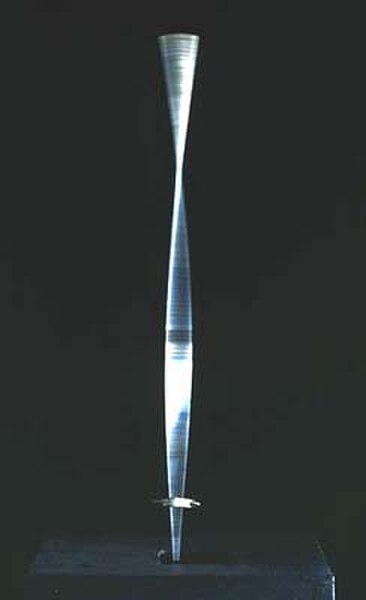
Naum Gabo, Kinetic Construction, also titled Standing Wave (1919–20)
Édouard Manet, Le Ballet Espagnol (1862).
At the Races, 1877–1880, oil on canvas, by Edgar Degas, Musée d'Orsay, Paris
Edgar Degas, The Orchestra at the Opera (c. 1870)