Assyrian homeland
Videos
The Assyrian homeland or Assyria is the homeland of the Assyrian people within which Assyrian civilisation developed, located in the Upper Mesopotamia of West Asia. The territory that forms the Assyri
King Ashurnasirpal II of the Assyrian Empire meets a high official during a review of soldiers and war prisoners. He is accompanied by a parasol-bearer and is watched over by a winged deity (Ashur). He holds a bow and a pair of raised arrows, symbolising victory in battle. From the North-West Palace at Nimrud, Mesopotamia (modern-day Iraq), about 865-860 BC


Rabban Hormizd Monastery, Alqosh, Nineveh, Iraq.

Mor Hananyo Monastery, or The Saffron Monastery in the Tur Abdin region.

Saint Mary Church: an ancient Assyrian church located in the city of Urmia, West Azerbaijan Province, Iran.
Shamash
Videos
Shamash, also known as Utu, was the ancient Mesopotamian sun god. He was believed to see everything that happened in the world every day, and was therefore responsible for justice and protection of tr
Assyrian homeland
…Assyria ܐܬܘܪ (Classical Syriac) Āṯōr Flag Star of Shamash The Assyrian Triangle was the proposed borders for an autonomous Assyrian state following World War I. Main languages Neo-Aramaic Mesopotamian Arabic…

Representation of Shamash from the Tablet of Shamash (c. 888 – 855 BC), showing him sitting on his throne dispensing justice while clutching a rod-and-ring symbol

Fired clay statue of a seated god, probably Shamash. From Ur, Iraq. Old-Babylonian period, 2000-1750 BCE. British Museum
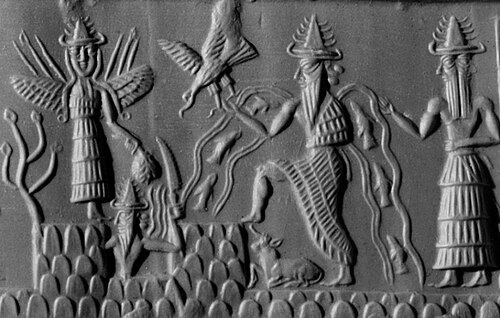
Detail of a cylinder seal from Sippar (2300 BC) depicting Shamash with rays rising from his shoulders and holding a saw-toothed knife with which he cuts his way through the mountains of the east at dawn (British Museum)

Old Babylonian cylinder seal impression depicting Shamash surrounded by worshippers (c. 1850-1598 BC)