Atmosphere of Earth
Videos
The atmosphere of Earth consists of a layer of mixed gas that is retained by gravity, surrounding the Earth's surface. It contains variable quantities of suspended aerosols and particulates that creat

Earth's atmosphere from space, showing a blue layer at the stratosphere, above the clouds of the troposphere. The Moon is visible as a crescent in the background.

Afterglow of the troposphere (orange), the stratosphere (blue) and the mesosphere (dark) at which atmospheric entry begins, leaving smoke trails, such as in this case of a spacecraft reentry
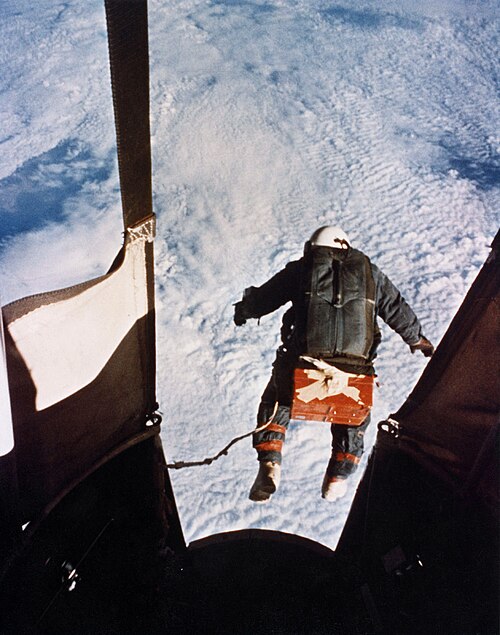
In 1960, Joseph Kittinger set a record by parachuting from a gondola at 31.3 km (19.4 mi)

Earth from orbit, showing sunlight filtered into a reddish hue by the troposphere, while casting shadows from different cloud types. The stratosphere forms a thin band of blue scattered sunlight along the horizon.
Stratosphere
Videos
The Stratosphere is the second-lowest layer of Earth's atmosphere, located above the troposphere and below the mesosphere. Pronounced, the name originates from Ancient Greek στρωτός 'layer, stratum' a
Atmosphere of Earth
…of space. Several layers can be distinguished in the atmosphere based on characteristics such as temperature and composition, namely the troposphere, stratosphere, mesosphere, thermosphere (formally the ionosphere), and exosphere. Air composition, temperature and atmospheric pressure vary with altitude. Air…

The ozone layer in the stratosphere blocks harmful UV radiation from reaching the surface of the Earth. A gamma-ray burst would deplete the ozone layer, allowing UV radiation through.

Aircraft typically cruise at the stratosphere to avoid turbulence rampant in the troposphere. The blue beam in this image is the ozone layer, beaming further to the mesosphere. The ozone heats the stratosphere, making conditions stable. The stratosphere is also the altitude limit of jets and weather balloons, as air is roughly a thousand times thinner there than at the troposphere.

Lightning extending above the troposphere into the stratosphere as blue jet and reaching into the mesosphere as red sprite