The attack on Fatima's house refers to a disputed violent attack on the house of Fatima, daughter of the Islamic prophet Muhammad. The attack is said to have taken place shortly after the death of Muhammad in 11 AH and was instigated by his successor Abu Bakr and led by Umar, another companion. The purpose of the attack was to arrest Fatima's husband Ali, who had withheld his pledge of allegiance to Abu Bakr. Her injuries during the raid might have caused the young Fatima's miscarriage and death within six months of Muhammad.
The door of Fatima's House
Fatima bint Muhammad, commonly known as Fatima al-Zahra', was the daughter of the Islamic prophet Muhammad and his wife Khadija. Fatima's husband was Ali, the fourth of the Rashidun Caliphs and the first Shia Imam. Fatima's sons were Hasan and Husayn, the second and third Shia Imams, respectively. Fatima has been compared to Mary, mother of Jesus, especially in Shia Islam. Muhammad is said to have regarded her as the best of women and the dearest person to him. She is often viewed as an ultimate archetype for Muslim women and an example of compassion, generosity, and enduring suffering. It is through Fatima that Muhammad's family line has survived to this date. Her name and her epithets remain popular choices for Muslim girls.
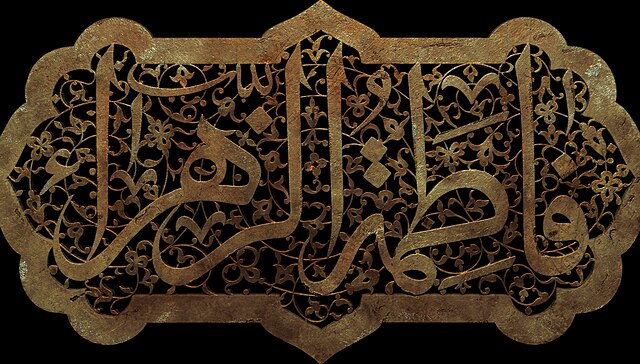
Artwork with Fatima's name, reconstruction from a Safavid piece
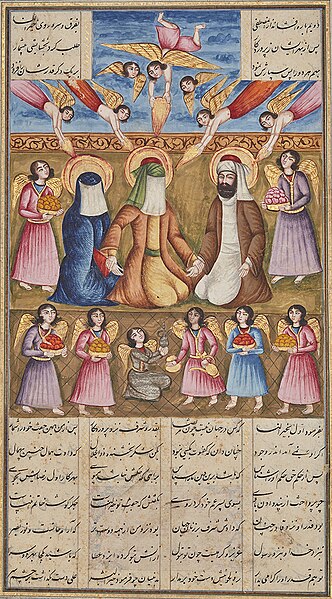
The marriage of Ali and Fatima. Artwork created in Iran, c. 1850
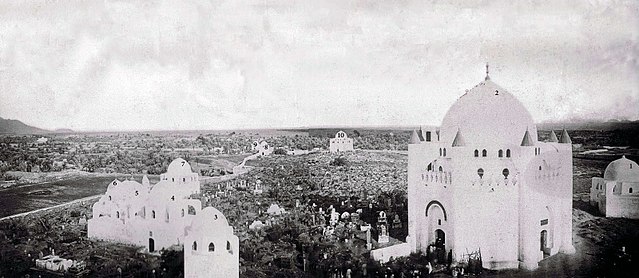
Al-Baqi' cemetery is a probable site for Fatima's grave, depicted here before the demolition of its mausoleums by the Wahhabis in 1927.
Arabic calligraphy of the verse of purification