The gens Aurelia was a plebeian family at ancient Rome, which flourished from the third century BC to the latest period of the Empire. The first of the Aurelian gens to obtain the consulship was Gaius Aurelius Cotta in 252 BC. From then to the end of the Republic, the Aurelii supplied many distinguished statesmen, before entering a period of relative obscurity under the early emperors. In the latter part of the first century, a family of the Aurelii rose to prominence, obtaining patrician status, and eventually the throne itself. A series of emperors belonged to this family, through birth or adoption, including Marcus Aurelius and the members of the Severan dynasty.
Denarius of Lucius Aurelius Cotta, 105 BC. The obverse is identical to the coins of Lipara, captured by Gaius Aurelius Cotta in 252 BC. The reverse depicts the triumph awarded for this victory.
Denarius of Marcus Aurelius Cotta, 139 BC.
Marcus Aurelius Antoninus was Roman emperor from 161 to 180 and a Stoic philosopher. He was a member of the Nerva–Antonine dynasty, the last of the rulers later known as the Five Good Emperors and the last emperor of the Pax Romana, an age of relative peace, calm, and stability for the Roman Empire lasting from 27 BC to 180 AD. He served as Roman consul in 140, 145, and 161.
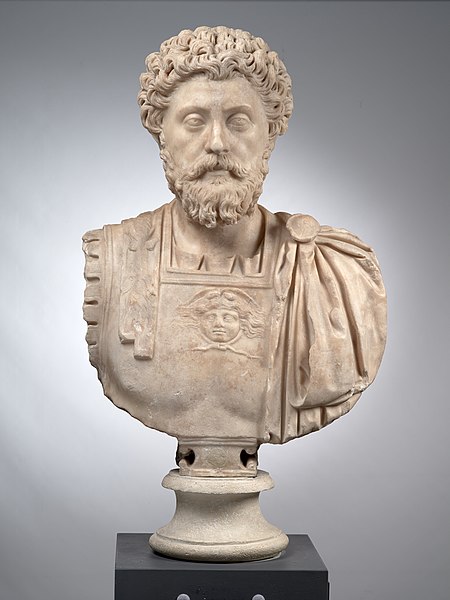
Marble bust, Musée Saint-Raymond
A bust of young Marcus Aurelius (Capitoline Museum). Anthony Birley, his modern biographer, writes of the bust: 'This is certainly a grave young man'.
Sestertius of Antoninus Pius (AD 140–144). It celebrates the betrothal of Marcus Aurelius and Faustina the Younger in 139, pictured below Antoninus, who is holding a statuette of Concordia and clasping hands with Faustina the Elder. Inscription: ANTONINVS AVG. PIVS P. P., TR. P., CO[N]S. III / CONCORDIAE S.C.
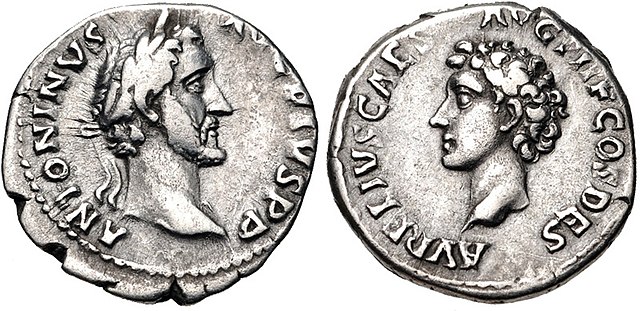
Denarius of Antoninus Pius (AD 139), with a portrait of Marcus Aurelius on the reverse. Inscription: ANTONINVS AVG. PIVS P. P. / AVRELIVS CAES. AVG. PII F. CO[N]S. DES.