Auriga
Videos
Auriga is a constellation in the northern celestial hemisphere. It is one of the 88 modern constellations; it was among the 48 constellations listed by the 2nd-century astronomer Ptolemy. Its name is
A painting by Peter Paul Rubens entitled Finding of Erichthonius; Erichthonius and Auriga are often associated.

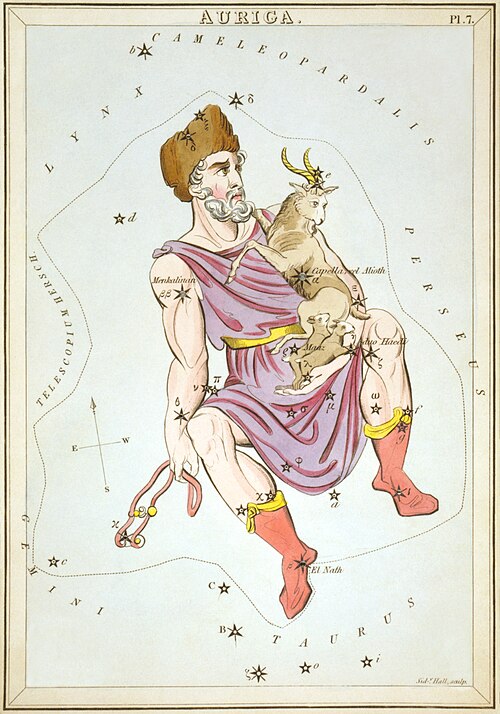
Auriga carrying the goat and kids as depicted in Urania's Mirror, a set of constellation cards illustrated by Sidney Hall, London c. 1825.

The constellation Auriga as it can be seen by the naked eye.

The Flaming Star Nebula (IC 405), and its neighbor IC 410, along with AE Aurigae, which illuminates the nebula.
Perseus (constellation)
Videos
Perseus is a constellation in the northern sky, named after the Greek mythological hero Perseus. It is one of the 48 ancient constellations listed by the 2nd-century astronomer Ptolemy, and among the
Auriga
…star Capella (α Aur) (0.08m) Nearest star QY Aur Messier objects 3 Meteor showers Aurigids Delta Aurigids Bordering constellations Camelopardalis Perseus Taurus Gemini Lynx Visible at latitudes between +90° and −40°. Best visible at 21:00 (9 p.m.) during the month of February. Auriga is a constellation…

Perseus carrying the head of Medusa the Gorgon, as depicted in Urania's Mirror, a set of constellation cards published in London c.1825

The constellation Perseus as it can be seen by the naked eye

The Double Cluster (NGC 869 and NGC 884)

NGC 1333, a nebula in the Perseus molecular cloud featuring glowing gases and pitch-black dust stirred up and blown around by several hundred newly forming stars embedded within the dark cloud.