Aurora
Videos
An aurora is a natural light display in Earth's upper atmosphere caused by charged particles from the Sun colliding with atoms in the atmosphere. These collisions excite oxygen and nitrogen, which the

Earth's night-side upper atmosphere appears from the bottom as bands of afterglow illuminating the troposphere in orange with silhouettes of clouds at the top, and the stratosphere in white and blue at the top of the middle. Next, the mesosphere (pink area) extends to the orange and faintly green line of the lowest airglow, at about one hundred kilometres at the edge of space and the lower edge of the thermosphere (invisible). Continuing with green and red bands of auroras stretching over several hundred kilometres.

Different forms

Divergence point of a coronal aurora

2024 appearance seen in England radiating blue through red aurora
Solar wind
Videos
The solar wind is a stream of charged particles released from the Sun's outermost atmospheric layer, the corona. This plasma mostly consists of electrons, protons and alpha particles with kinetic ener
Aurora
…spirals or dynamic flickers covering the entire sky. Auroras are the result of disturbances in the Earth's magnetosphere caused by enhanced speeds of solar wind from coronal holes and coronal mass ejections. These disturbances alter the trajectories of charged particles in the magnetospheric plasma. These…

Laboratory simulation of the magnetosphere's influence on the solar wind; these aurora-like Birkeland currents were created in a terrella, a magnetised anode globe in an evacuated chamber.

This is thought to show the solar wind from the star L.L. Orionis generating a bow shock (the bright arc).
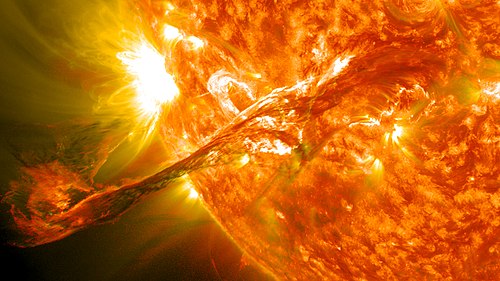
CME erupts from the Sun

Apollo's SWC experiment