Australian Flying Corps
Videos
The Australian Flying Corps (AFC) was the branch of the Australian Army responsible for operating aircraft during World War I, and the forerunner of the Royal Australian Air Force (RAAF). The AFC was established in 1912, though it was not until 1914 that it began flight training.
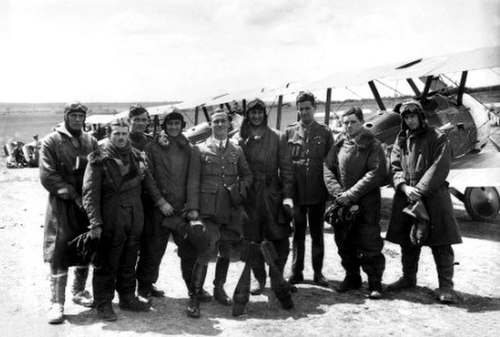
Captain Harry Cobby (centre), Lieutenant Roy King (fourth from right), and other officers of "A" Flight, No. 4 Squadron AFC, with their Sopwith Camels on the Western Front, June 1918

Members of the Half Flight gather around a Royal Naval Air Service Short 827

R.E.8s of No 3 Sqn AFC
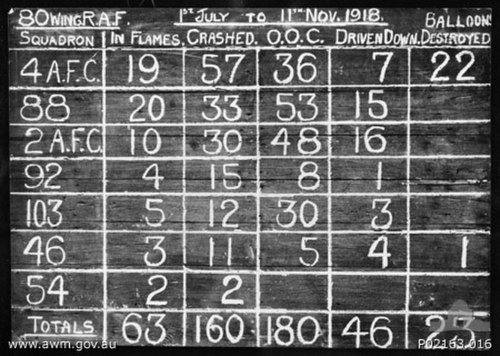
Serny, France, November 1918. A score board recording the claims for enemy aircraft destroyed by No. 80 Wing RAF from July–November 1918, including Nos. 2 and 4 Squadron AFC.
Central Flying School RAAF
Videos
Central Flying School (CFS) is a Royal Australian Air Force (RAAF) training unit, located at RAAF Base East Sale, Victoria. It operates the Pilatus PC-21 turboprop trainer. The school is responsible for training flight instructors, setting flying standards, and auditing flying practices. It is also home to the "Roulettes" aerobatic team. CFS was the first military aviation unit to be formed in Australia, in 1913, when its role was to provide basic flying training. Its current form dates from World War II, when it was re-established to train flying instructors for the Empire Air Training Scheme (EATS).

Lieutenants Harrison (left) and Petre (right) in a B.E.2 at Central Flying School, Point Cook, 1914

Bristol Boxkite over Point Cook, c. March 1916

Central Flying School staff, shortly after the unit arrived at RAAF Station Camden, May 1940. Pictured include Flight Lieutenant (later Air Vice Marshal) B.A. Eaton (fourth from left) and Flying Officer I.F. Rose (centre, capless), commanding officer of the school in 1946–48.

Inspection of Australian-built Lincoln at CFS, 1946