Austria-Hungary
Videos
Austria-Hungary, also referred to as the Austro-Hungarian Empire and officially as the Austro-Hungarian Monarchy, was a multi-national empire in Central Europe under a constitutional dual monarchy tha

Coronation of Franz Joseph I and Elisabeth Amalie at Matthias Church, Buda, 8 June 1867

Recruits from Bosnia-Herzegovina, including Muslim Bosniaks (31%), were drafted into special units of the Austro-Hungarian Army as early as 1879 and were commended for their bravery in service of the Austrian emperor, being awarded more medals than any other unit. The military march "Die Bosniaken kommen" was composed in their honor by Eduard Wagnes.

Bosnian Muslim resistance during the battle of Sarajevo in 1878 against the Austro-Hungarian occupation

k.u.k. infantry in 1898
Flags of Austria-Hungary
Videos
The empire of Austria-Hungary did not have a commonly used universal flag. A single "national flag" could not exist since the Dual Monarchy consisted of two nations brought together by the 1867 Austro
Austria-Hungary
…Austro-Hungarian Monarchy Österreichisch-Ungarische Monarchie Osztrák–Magyar Monarchia 1867–1918 Coat of arms (1915–1918) (see also: Flags of Austria-Hungary) Motto: Indivisibiliter ac inseparabiliter (Latin for 'Indivisibly and inseparably') Anthem: Gott erhalte, Gott beschütze (English: God preserve, God…

Emperor's Gratitude by Ludwig Koch from 1915. Visible various flags used in Austria-Hungary

Visit of Emperor Franz Joseph I in Kraków, visible unidentified red-white flag, regional white-blue city flags, imperial standard and black-gold flag, 1880
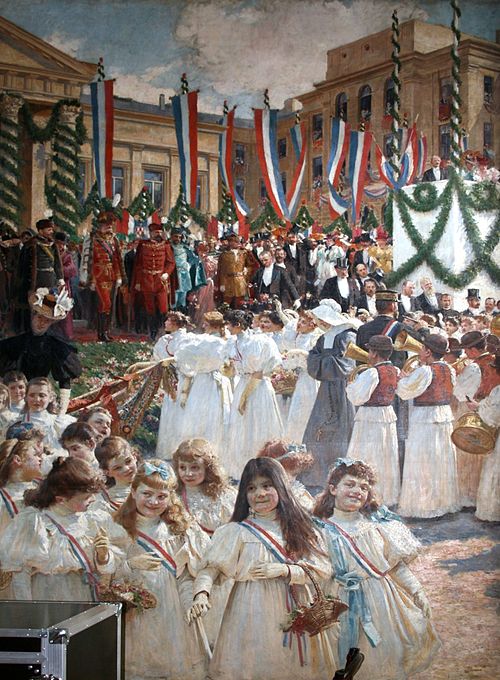
Visit of Emperor Franz Joseph I in Zagreb, red-white-blue (Croatian) flags, 1895

Civil ensign and Austrian pennants on a French illustration advertising the Hungarian pavilion during Exposition Universelle in Paris, 1900