Austria and Prussia were the most powerful states in the Holy Roman Empire by the 18th and 19th centuries and had engaged in a struggle for supremacy among smaller German kingdoms. The rivalry was characterized by major territorial conflicts and economic, cultural, and political aspects. Therefore, the rivalry was an important element of the so-called German question in the 19th century.
Frederick II of Prussia and Joseph II, Holy Roman Emperor meet at Neisse on 25 August 1769
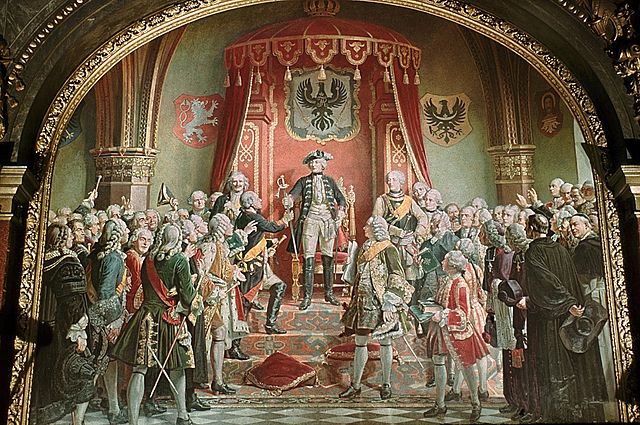
Frederick receives homage from the Silesian estates, wall painting by Wilhelm Camphausen, 1882
The "German question" was a debate in the 19th century, especially during the Revolutions of 1848, over the best way to achieve a unification of all or most lands inhabited by Germans. From 1815 to 1866, about 37 independent German-speaking states existed within the German Confederation. The Großdeutsche Lösung favored unifying all German-speaking peoples under one state, and was promoted by the Austrian Empire and its supporters. The Kleindeutsche Lösung sought to unify only the northern German states and did not include any part of Austria ; this proposal was favored by the Kingdom of Prussia.
German unity as fiasco with each state viewing itself separate. Cartoon from Münchner Leuchtkugeln, 1848. Caption reads: "German Unity. A Tragedy in one Act."
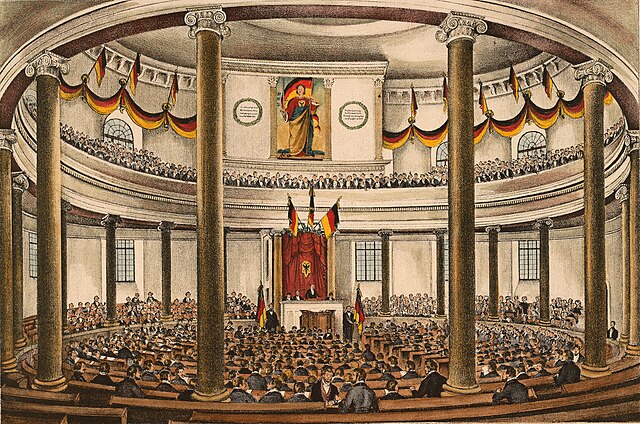
First German National assembly at St. Paul's Church, Frankfurt 1848/49
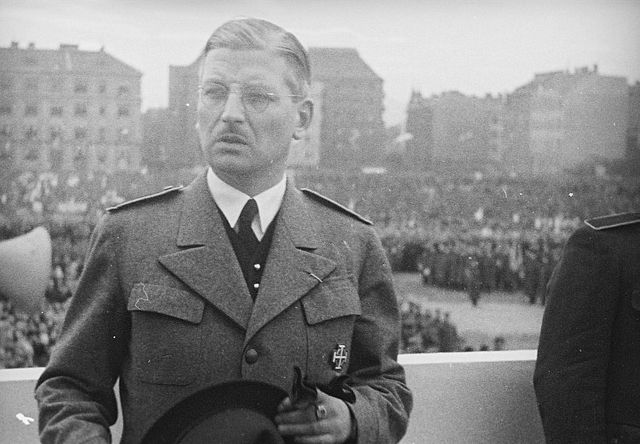
Kurt Schuschnigg, Austrian chancellor from 1934 to 1938, strongly opposed Hitler's annexation of Austria to Nazi Germany.
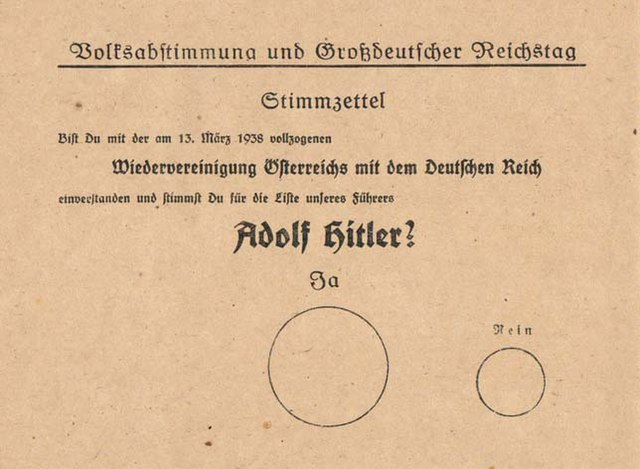
Voting ballot from 10 April 1938. The ballot text reads, "Do you agree with the reunification of Austria with the German Reich that was enacted on 13 March 1938, and do you vote for the party of our leader Adolf Hitler?" The large circle is labeled "Yes", the smaller "No".