Avatar
Videos
Avatar is a concept within Hinduism that in Sanskrit literally means 'descent'. The concept, with a different name, can also be found within Buddhism and Yazidism. It signifies the material appearance
Present image. Description: "Hindu god Vishnu (centre) surrounded by his ten major avatars (Krishna-Buddha version). Anticlockwise from top left: Matsya; Kurma; Varaha; Narasimha; Vamana; Parashurama; Rama; Krishna; Buddha and Kalki"


Proposal: "Vishnu with his 10 avatars (incarnations): Fish, Tortoise, Boar, Man-Lion, Dwarf, Rama with the Ax, King Rama, Krishna, Buddha, and Kalkin. Painting from Jaipur, India, 19th century; in the Victoria and Albert Museum, London. Opaque watercolour on paper. Height: 48.3 cm, Width: 39.5 cm. Acquired by the Indian Museum and transferred to the South Kensington Museum in 1879."

Mohini, the female avatar of Vishnu (statue at Belur temple, Karnataka.)

Sharabha (right) with Narasimha (18th-century painting, Pahari/Kangra School)
Vishnu
Videos
Vishnu, also known as Narayana and Hari, is one of the principal deities of Hinduism. He is the Supreme Being within Vaishnavism, one of the major traditions within contemporary Hinduism, and the god
Avatar
…Bhagavad Gita expounds the doctrine of Avatara but with terms other than avatar. Theologically, the term is most often associated with the Hindu god Vishnu, though the idea has been applied to other deities. Varying lists of avatars of Vishnu appear in Hindu scriptures, including the ten Dashavatara of the…
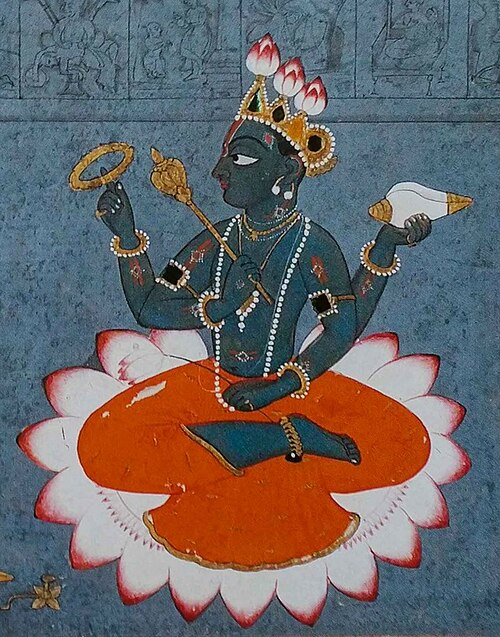
Painting depicting Vishnu, c. 1730

Vishnu Gandhara

Museum für Indische Kunst Dahlem Berlin Mai 2006 036 2
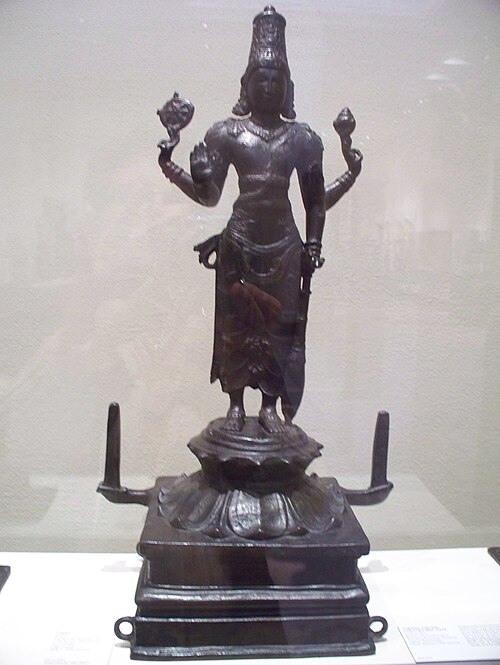
Statue of Vishnu, Victoria and Albert Museum, London, UK 20090209