BTR-D
Videos
The BTR-D is a Soviet airborne multi-purpose tracked armoured personnel carrier. It was introduced in 1974 and first seen by the West in 1979 during the Soviet–Afghan War. BTR-D stands for Bronetransp

BTR-D with parachute landing equipment

Airborne operations demonstrating full deployment of the parachute system and underslung BTR-D.

BTR-D with dismounted infantry (the vehicle can carry up to 10 fully equipped troops plus crew).

BTR-ZD anti-aircraft variant which has additional internal storage for MANPADS and has mounting points to strap a ZU-23-2 automatic cannon (pictured).
BMD-1
Videos
The BMD-1 is a Soviet airborne amphibious tracked infantry fighting vehicle, which was introduced in 1969 and first seen by the West in 1970. BMD stands for Boyevaya Mashina Desanta. It can be dropped
BTR-D
…stands for Bronetransportyor Desanta (БТР-Д, Бронетранспортер Десанта, literally "Armored personnel carrier of the Airborne Forces"). It is based on the BMD-1 airborne IFV. NATO gave it the designation BMD M1979. In 1969, the BMD-1 airborne IFV entered service with the Soviet Army. The vehicle had many flaws…

BMD-1 in Russian service, 2011.

BMD-1 three-view graphic.

BMD-1 of the Armed Forces of Ukraine being rigged up for parachute drop before being loaded onto an Il-76 transport aircraft, 2006.
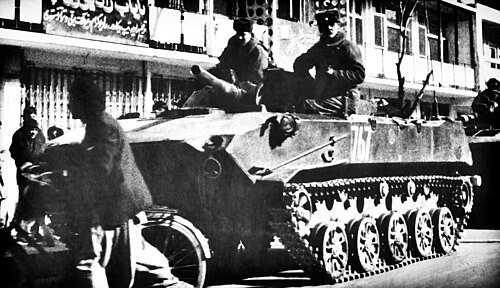
Soldiers ride on top of a BMD-1 in Kabul, Afghanistan, 25 March 1986.