Bactrian language
Videos
Bactrian was an Eastern Iranian language formerly spoken in the Central Asian region of Bactria and used as the official language of the Kushan and the Hephthalite empires.
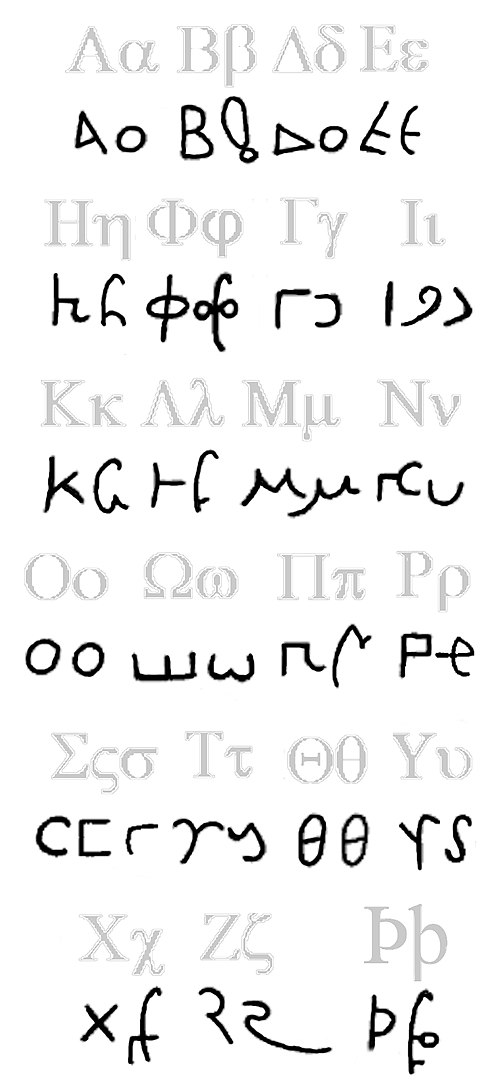
The Bactrian alphabet (block and cursive letters, here in black). The Bactrian script was directly adapted from the Greek script (here in grey), with the addition of the letter sho (ϸ).

The Rabatak inscription is an inscription written on a rock in the Bactrian language and the Greek script, which was found in 1993 at the site of Rabatak, near Surkh Kotal in Afghanistan. The inscription relates to the rule of the Kushan emperor Kanishka, and gives remarkable clues on the genealogy of the Kushan dynasty.

The word αλχοννο (alkhonno) in cursive Bactrian script, on a coin of the Alchon Huns ruler Khingila, 5th century AD.

The Surkh Kotal inscription (SK4) is the first known substantial document written in Bactrian, an Iranian language. It uses the Greek script. It was written at the time of the Kushan ruler Huvishka, 2nd century CE. Kabul Museum.
Bactria
Videos
Bactria, or Bactriana, was an ancient Iranian civilization in Central Asia, located in the area south of the Oxus River and north of the Hindu Kush mountains, within modern-day Afghanistan, Tajikistan
Bactrian language
…Bactrian (Bactrian: Αριαο, romanized: ariao , meaning "Iranian") was an Eastern Iranian language formerly spoken in the Central Asian region of Bactria (some regions of present-day Afghanistan, Uzbekistan and Tajikistan) and used as the official language of the Kushan and the Hephthalite empires. It…

Xerxes I tomb, Bactrian soldier c. 470 BC.

Pre-Seleucid Athenian owl imitation from Bactria, possibly from the time of Sophytes.

Gold stater of the Greco-Bactrian king Eucratides

The treasure of the royal burial Tillia tepe is attributed to 1st century BC Sakas in Bactria.