Banavasi
Videos
Banavāsi is an ancient temple town located near Sirsi in Karnataka. Banavasi was the ancient capital of the Kadamba dynasty that ruled all of modern-day Karnataka state. They were the first native emp

Madhukeshwara Temple at Banavasi

Coin of the Kadamba king who calls himself on the coin "sri dosharashi," thought to be Krishnavarma II (ruled c. 516-540). The reverse of the coin has the legend shashanka, which means "moon." The Kannada letters and another coin can be seen in the entry for Kadambas of Banavasi
Kadamba dynasty
Videos
The Kadamba dynasty were an ancient royal family from modern Karnataka, India, that ruled northern Karnataka and the Konkan from Banavasi in present-day Uttara Kannada district in India. The kingdom w
Banavasi
…Banavāsi is an ancient temple town located near Sirsi in Karnataka. Banavasi was the ancient capital of the Kadamba dynasty that ruled all of modern-day Karnataka state. They were the first native empire to bring Kannada and Karnataka to prominence. It is 24 km (15 mi) away…

The Talagunda pillar Sanskrit Inscription of crown prince Santivarma (c. 450)
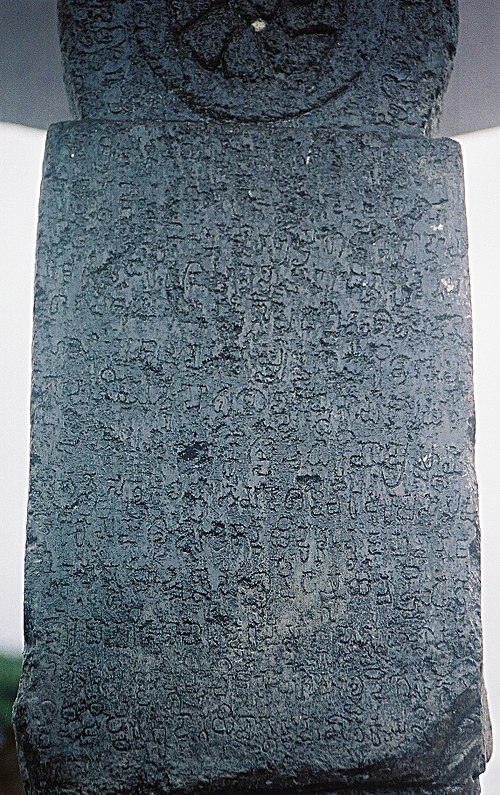
The Halmidi inscription at Halmidi village, usually dated 450 CE. is the earliest Kannada inscription issued by the Kadamba dynasty

Old Kannada inscriptions of Kadamba king Kamadeva of the Hangal branch (c. 1180) and Hoysala king Veera Ballala II (c. 1196) in the open mantapa of the Tarakeshwara temple at Hangal

Old Kannada inscription (1200 AD) of King Kamadeva of the Kadamba dynasty of the Hangal branch