Barbette
Videos
Barbettes are several types of gun emplacement in terrestrial fortifications or on naval ships.

US Army 16-inch gun M1919 on barbette mount M1919; this was a high-angle mount with elevation to 65°.
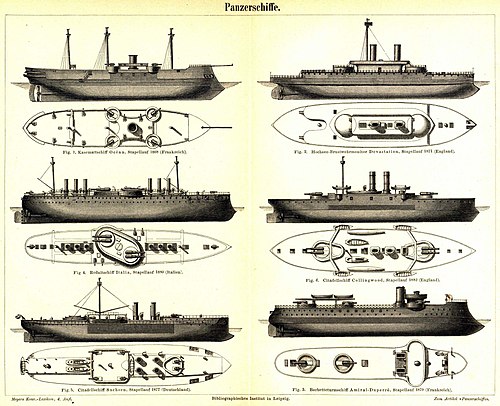
Illustration of several armored ships from the 1880s, showing the degree of experimentation with armament arrangements
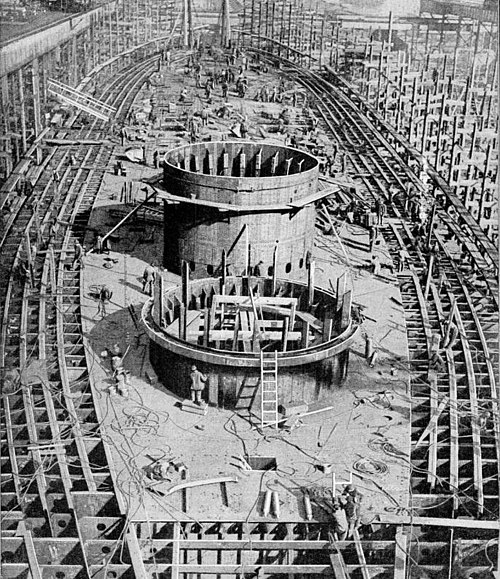
USS Maryland under construction in 1917, showing the forward two barbettes without the gun turrets installed

Rear "Cheyenne"-pattern gun position on a B-17G Flying Fortress
Disappearing gun
Videos
A disappearing gun, a gun mounted on a disappearing carriage, is an obsolete type of artillery which enabled a gun to hide from direct fire and observation. The overwhelming majority of carriage designs enabled the gun to rotate backwards and down behind a parapet, or into a pit protected by a wall, after it was fired; a small number were simply barbette mounts on a retractable platform. Either way, retraction lowered the gun from view and direct fire by the enemy while it was being reloaded.
It also made reloading easier, since it lowered the breech to a level just above the loading platform, and shells could be rolled right up to the open breech for loading and ramming. Other benefits over non-disappearing types were a higher rate of repetitive fire and less fatigue for the gun crew.
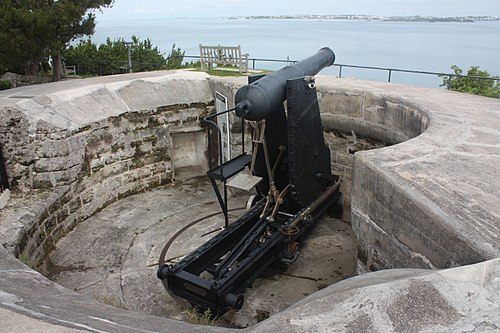
British 64 pounder rifled muzzle-loading (RML) gun on a Moncrieff disappearing mount, at Scaur Hill Fort, Bermuda

The BL 8 inch disappearing gun of the South Battery, at North Head in Devonport, New Zealand

A U.S. Coast Artillery battery with two guns on disappearing carriages

Annotated photograph of an M1901 Buffington–Crozier disappearing carriage for an M1900 12-inch gun