Batavi (Germanic tribe)
Videos
The Batavians or Batavi were a Roman-era Germanic people that lived in Batavia in the eastern Rhine delta — an area that is now in the Netherlands, but then lay upon the northernmost border of the Rom

The Conspiracy of the Batavians under Claudius Civilis by Rembrandt van Rijn
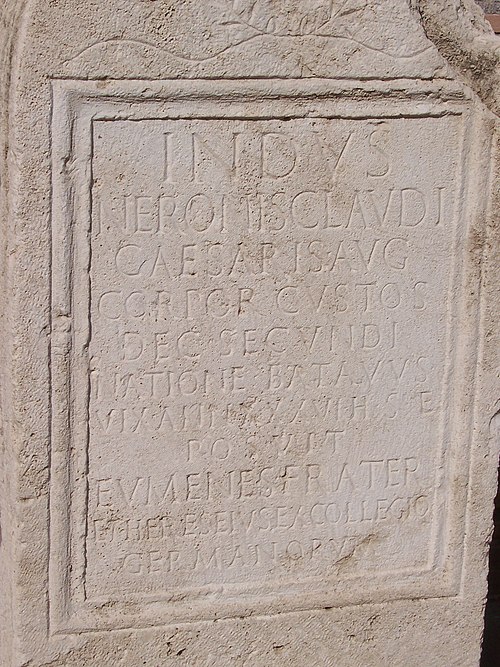
Funerary stela of one of Nero's Corporis Custodes, the imperial Germanic bodyguard. The bodyguard, Indus, was of the Batavian tribe.

A Roman cavalry helmet, discovered in 1915 near Nijmegen, from the second half of the first century, at Valkhof Museum
Revolt of the Batavi
Videos
The Revolt of the Batavi took place in the Roman province of Germania Inferior between AD 69 and 70. It was an uprising against the Roman Empire started by the Batavi, a small but militarily powerful
Batavi (Germanic tribe)
…important role in the Roman subjugation of Britain. In 69 AD, the "Year of the Four Emperors", Julius Civilis, a Batavi leader and Roman citizen, led the Batavian Revolt during a period when several Roman leaders were fighting for control of the empire. The revolt involved not only the Batavi and their neighbours the…

Silver-plated medal, denoting the property of C. Aquilius Proculus, the primus pilus who organized the retreat of Roman troops from the Rhineland and was betrayed by his local auxiliaries. (Tac. Historiae IV.18). The medal was found on the Kops Plateau in Nijmegen.

Reconstruction of a Roman fluvial boat, a navis lusoria of the classis germanica (Rhine flotilla). It is based on the remarkable discovery of the remains of five Roman boats at Mainz in the early 1980s. The boat above, denoted Mainz Type A, was designed as a rapid intervention launch, with long, narrow shape and shallow keel. It would be rowed by the troops themselves (32 oars, 16 on each side). Note the mounted shields to protect the oarsmen from missiles shot from the riverbanks. At the time of