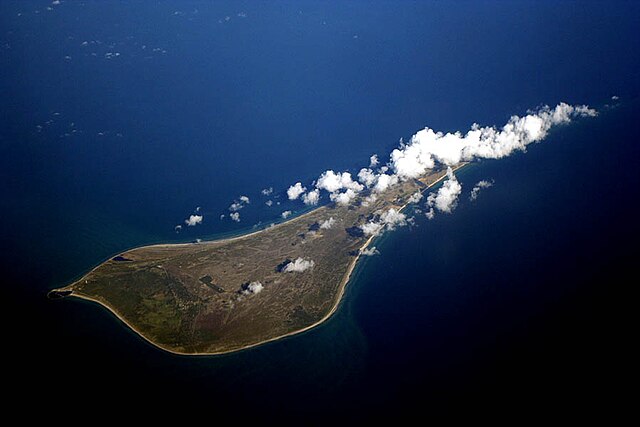
The Battle of Anholt was a successful British military operation under the command of James Wilkes Maurice against the Danish-held island of Anholt under the command of Jørgen Conrad de Falsen, taking place during the Gunboat War, a conflict between the United Kingdom and Denmark-Norway that was part of the wider Napoleonic Wars. It was an attempt by the Dano-Norwegians to recapture Anholt, a small Danish island off the coast of Jutland which the British had captured in 1809. Early in the Gunboat War, the Dano-Norwegians had closed their lighthouse at the easternmost point of Anholt. In January 1809, the bomb-vessel Proselyte, which the British had stationed off Anholt to act as a lighthouse, struck Anholt Reef and sank. On 18 May 1809, the 74-gun Third Rate HMS Standard, under Captain Askew Hollis, led in a squadron that also included the frigate Owen Glendower, and the vessels Avenger, Ranger, Rose, and Snipe. Together they captured the island.
An aerial view of the island of Anholt
Plan of the events on 27 March 1811
Vice-Admiral James Wilkes Maurice was an officer of the Royal Navy during the French Revolutionary and Napoleonic Wars. Unlike his contemporaries who won fame commanding ships, Maurice gained accolades for his command of a number of island fortresses.
A cannon is hauled up to the summit of the rock suspended by a cable from Centaur's mainmast
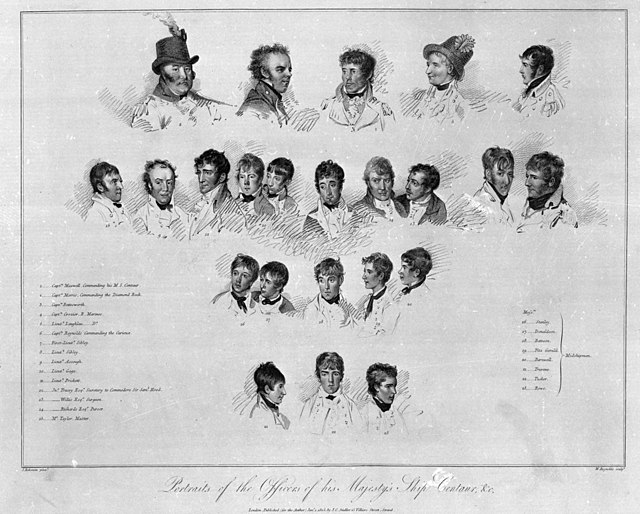
A collection of portraits of those involved in the establishment, operation and defence of Diamond Rock. Centre, top row, is Captain Murray Maxwell, commanding officer of HMS Centaur. Second from left, top row, is James Maurice, commander of the rock.
The French fleet under Captain Cosmao attacking Diamond Rock, by Auguste Mayer