The Battle of Beecher Island, also known as the Battle of Arikaree Fork, was an armed conflict between elements of the United States Army and several of the Plains Native American tribes in September 1868. Beecher Island, on the Arikaree River, then known as part of the North Fork of the Republican River, near present-day Wray, Colorado, was named afterwards for Lieutenant Fredrick H. Beecher, an army officer killed during the battle.
Roman nose is shot (from an 1895 book)
Defending the Island One soldier and three horses have fallen, while others continue to wage the battle.
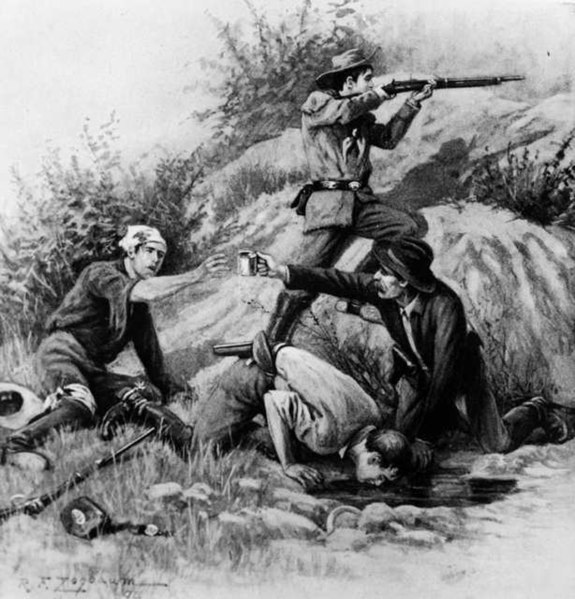
In the pits An officer hands a wounded soldier water as another man drinks from a pool, while a third prepares to fire his rifle.
Chief Roman Nose Roman Nose, on horseback, taunts the U.S. soldiers as a group of spectators on horseback cheer him on.
10th Cavalry Regiment (United States)
The 10th Cavalry Regiment is a unit of the United States Army. Formed as a segregated African-American unit, the 10th Cavalry was one of the original "Buffalo Soldier" regiments in the post–Civil War Regular Army. It served in combat during the Indian Wars in the western United States, the Spanish–American War in Cuba, Philippine–American War and Mexican Revolution. The regiment was trained as a combat unit but later relegated to non-combat duty and served in that capacity in World War II until its deactivation in 1944.
10th Regiment United States Cavalry Coat of Arms description from 1911.
10th Regiment United States Cavalry insignia.
The Buffalo Soldier Monument at Fort Leavenworth, Kansas. It honors the African-American Buffalo soldiers and those who led them.
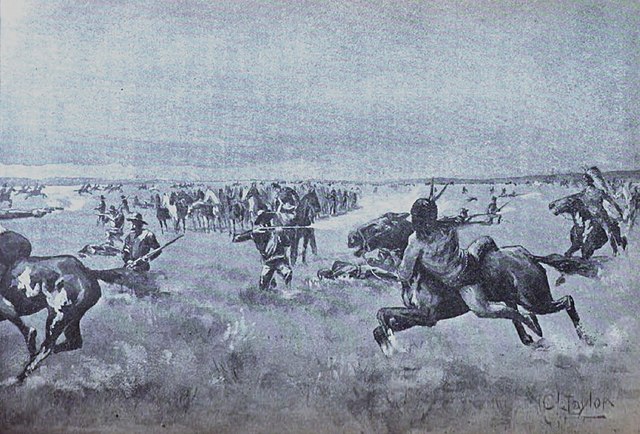
"Wounded and lifted on Horse"- A painting by C. Taylor from the book "Ups and Downs of an Army Officer" written by George A. Armes. The painting describes when the then Captain Armes was wounded in the hip and lifted up on a horse during the Battle of the Saline River in August 1867.