Battle of Beth Zur
Videos
The Battle of Beth Zur was fought between the Maccabees led by Judas Maccabeus and a Seleucid Greek army led by Regent Lysias in October 164 BC at Beth Zur. According to the books of Maccabees, the rebels won the battle, although how significant this victory really was is disputed; it is possible the battle's result was inconclusive. Through a stroke of good fortune for the rebels, the days after the battle likely coincided with news of Seleucid King Antiochus IV Epiphanes's death reaching Judea; rather than continue the campaign, the Seleucid army and Lysias returned to the capital to handle the leadership transition. The Maccabees were able to capture Jerusalem soon after.

The Ruins of Beth Zur, early 20th century

An angel aids the Maccabees (illustration by Gustave Doré in 1866)
Maccabean Revolt
Videos
The Maccabean Revolt was a Jewish rebellion led by the Maccabees against the Seleucid Empire and against Hellenistic influence on Jewish life. The main phase of the revolt lasted from 167 to 160 BCE and ended with the Seleucids in control of Judea, but conflict between the Maccabees, Hellenized Jews, and the Seleucids continued until 134 BCE, with the Maccabees eventually attaining independence.

Jerusalem and Judea during the revolt

A 14th century Christian work depicting Antiochus IV praying to a horned idol at the Temple. The Book of Daniel describes an "abomination of desolation" being given authority over the Temple, as well as the daily offering and sacrifice ceasing.
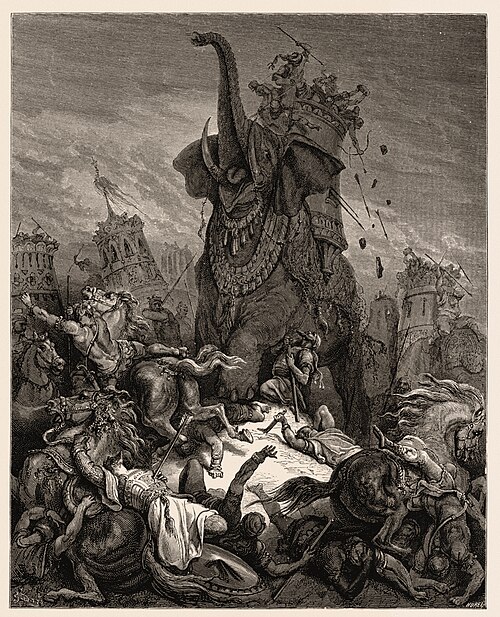
Eleazar Avaran trampled by a war elephant (illustration by Gustave Doré in 1866)

Jewish National Fund stamp (1938) invoking the Maccabees