Battle of Chaeronea (338 BC)
Videos
The Battle of Chaeronea was fought in 338 BC, near the city of Chaeronea in Boeotia, between Macedonia under Philip II and an alliance of city-states led by Athens and Thebes. The battle was the culmination of Philip's final campaigns in 339–338 BC and resulted in a decisive victory for the Macedonians and their allies.

An 1882 depiction of the Battle of Chaeronea, from Cassell's Illustrated Universal History

A bust of Philip II of Macedon

A bust of the Athenian politician Demosthenes

A funerary relief for Athenian footsoldier Panchares, who probably fell at the battle of Chaeronea.
Macedonia (ancient kingdom)
Videos
Macedonia, also called Macedon, was an ancient kingdom on the periphery of Archaic and Classical Greece, which later became the dominant state of Hellenistic Greece. The kingdom was founded and initially ruled by the royal Argead dynasty, which was followed by the Antipatrid and Antigonid dynasties. Home to the ancient Macedonians, the earliest kingdom was centered on the northeastern part of the Greek peninsula, and bordered by Epirus to the southwest, Illyria to the northwest, Paeonia to the north, Thrace to the east and Thessaly to the south.

The entrance to one of the royal tombs at Vergina, a UNESCO World Heritage Site

A silver octadrachm of Alexander I of Macedon (r. 498–454 BC), minted c. 465–460 BC, showing an equestrian figure wearing a chlamys (short cloak) and petasos (head cap) while holding two spears and leading a horse

A Macedonian didrachm minted during the reign of Archelaus I of Macedon (r. 413–399 BC)
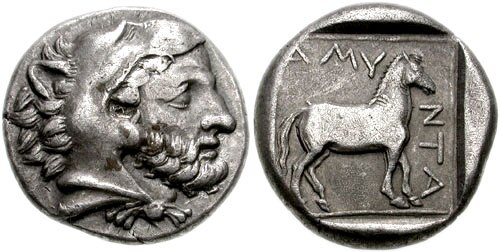
A silver stater of Amyntas III of Macedon (r. 393–370 BC)