Battle of Noemfoor
Videos
Photos
The Battle of Noemfoor was part of the New Guinea campaign of World War II. It took place on the island of Noemfoor, in Dutch New Guinea, between 2 July and 31 August 1944. During the battle, Allied forces landed on the island to capture Japanese bases as part of their advance through the Pacific towards the Philippines. The initial landing was largely unopposed and the Japanese defenders withdrew inland as the US troops came ashore. Sporadic fighting took place over the course of two months as the Allies secured the three airfields on the island and pushed the surviving Japanese troops to the southeastern coast. The island was later used by the Allies to support operations around Sansapor and on Morotai.

Noemfoor, 12 July 1944. A U.S. soldier points out the direction in which Japanese troops have retreated, to a comrade using a walkie-talkie. (Photographer: Allan F. Anderson)

U.S. Army M4 Sherman tanks and other vehicles disembarking from LSTs onto Noemfoor

Australian airfield construction personnel at Noemfoor
New Guinea campaign
Videos
Photos
The New Guinea campaign of the Pacific War lasted from January 1942 until the end of the war in August 1945. During the initial phase in early 1942, the Empire of Japan invaded the Territory of New Guinea on 23 January and Territory of Papua on 21 July and overran western New Guinea beginning on 29 March. During the second phase, lasting from late 1942 until the Japanese surrender, the Allies—consisting primarily of Australian forces—cleared the Japanese first from Papua, then New Guinea, and finally from the Dutch colony.

Australian forces attack Japanese positions near Buna
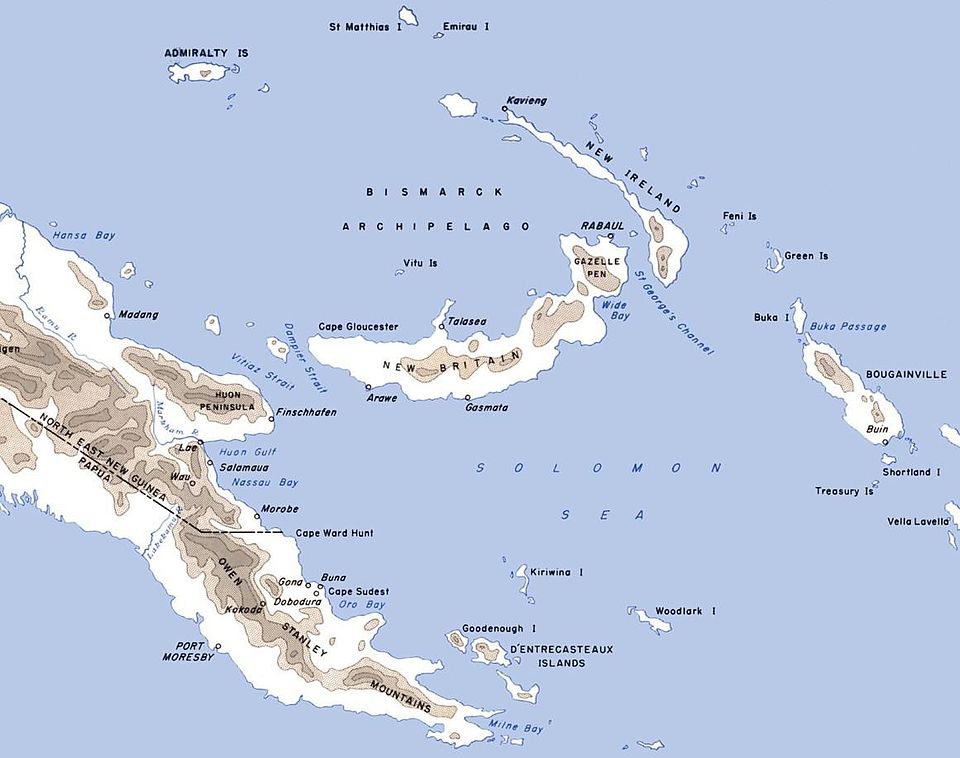
Papua New Guinea, the Bismarcks and the Northern Solomons

Two dead Japanese soldiers in a water filled shell hole somewhere in New Guinea

An Allied A-20 bomber attacks Japanese shipping during the Battle of the Bismarck Sea, March, 1943