Battle of Pavia
Videos
The Battle of Pavia, fought on the morning of 24 February 1525, was the decisive engagement of the Italian War of 1521–1526 between the Kingdom of France and the Habsburg Empire of Charles V, Holy Rom

Ruprecht Heller, The Battle of Pavia (1529), Nationalmuseum, Stockholm
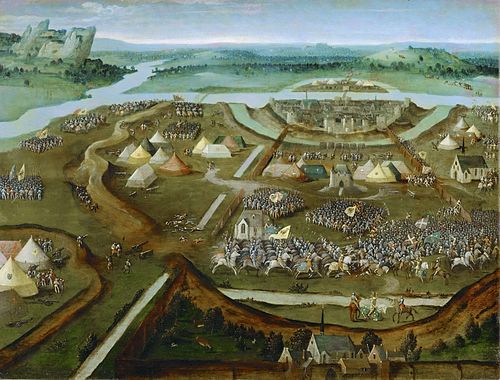
The Battle of Pavia, by a follower of Joachim Patinir

Joerg Breu, The Battle of Pavia, woodcut. c. 1525

Remains of the Porta Pescarina of the Visconti Park, San Genesio ed Uniti, where the Imperial troops entered the Park
Black Bands
Videos
The Black Bands, sometimes referred to as the Black Bands of Giovanni, was a company of Italian mercenaries formed and commanded by Giovanni de' Medici during the Italian Wars; their name came from th
Battle of Pavia
…troops. The French infantry consisted of 6,000 French foot soldiers and 17,000 foreign mercenaries: 8,000 Swiss, 5,000 Germans, and 4,000 Italians (Black Bands). The French cavalry consisted of 2,000 gendarmes and 1,200 lances fournies. Charles V, intending to break the siege, sent a relief force of 22,300…

Statue of the commander Giovanni de' Medici (also known as Giovanni delle Bande Nere) at the Uffizi Gallery in Florence, Italy.