Battle of Soissons (1918)
Videos
The Battle of Soissons was fought on the Western Front during World War I. Waged from 18 to 22 July 1918 between the French and the German armies, the battle was part of the much larger Allied Aisne-M

American heavy artillery at Soissons, 1918

Troops of the 16th Infantry rest near Berzy le Sec, France, 17 Jul 1918 the day before the attack at Soissons.

16th Infantry Regiment digging in north of Chaudun, 18 July 1918

La Verte-Feuille Farm after its capture by the 2nd Infantry Division (United States) on the morning of 18 July 1918.
Second Battle of the Marne
Videos
The Second Battle of the Marne was the last major German offensive on the Western Front during the First World War. The attack failed when an Allied counterattack, led by French forces and supported b
Battle of Soissons (1918)
…about 7 mi (11 km) from their starting point), the attack failed to achieve either of the two main objectives. The fifth and final spring offensive, Marneschutz-Reims, was two-pronged, aimed at capturing Reims and its rail center, giving the Germans complete control of the Reims–Soissons rail line. This would ease a…

German offensives, 1918

Captured British Mark IV tanks used by German troops

"German columns pass a conquered French position between Loivre and Brimont in the department of Marne." 1918. Credit to the German Archives.
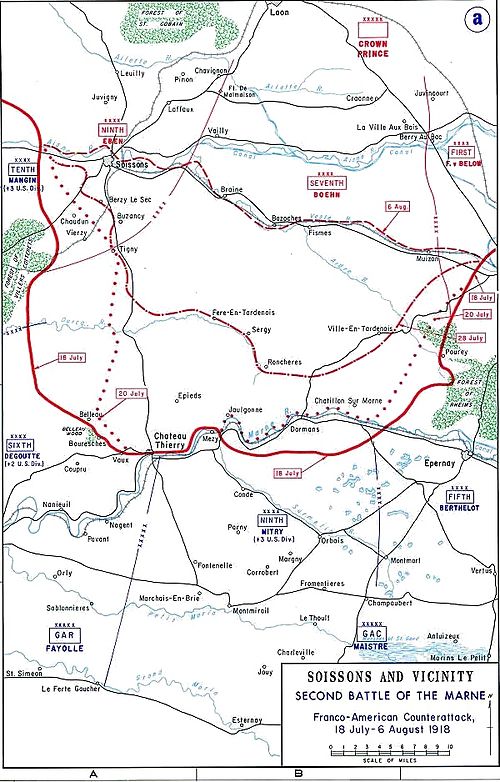
The Allied counter-offensive.