Belarus
Videos
Belarus, officially the Republic of Belarus, is a landlocked country in Eastern Europe. It is bordered by Russia to the east and northeast, Ukraine to the south, Poland to the west, and Lithuania and
Stamp with the Cross of St. Euphrosyne by Lazar Bohsha from 1992


Napoleon's Grande Armée retreating after his invasion of Russia and crossing the Berezina river (near Barysaw, Belarus)

The first government ("activists") of the Belarusian People's Republic (BNR, Беларуская Народная Рэспубліка), 1918. Sitting, left to right: Aliaksandar Burbis, Jan Sierada, Jazep Varonka, Vasil Zacharka. Standing, left to right: Arkadź Smolič, Pyotra Krecheuski, Kastuś Jezavitaŭ, Anton Ausianik, Liavon Zayats.

Meeting in the Kurapaty woods, 1989, where between 1937 and 1941 from 30,000 to 250,000 people, including Belarusian intelligentsia members, were murdered by the NKVD during the Great Purge
Belarusian language
Videos
Belarusian is an East Slavic language. It is one of the two official languages in Belarus, the other being Russian. It is also spoken in parts of Russia, Lithuania, Latvia, Poland, Ukraine, and the Un
Belarus
…of Piłsudski, a new wave of repressions was released upon the minorities, with many Orthodox churches and Belarusian schools being closed. Use of the Belarusian language was discouraged. Belarusian leadership was sent to Bereza Kartuska prison. In September 1939, the Soviet Union invaded and occupied eastern Poland…

Monolingually Belarusian sign by the Minsk metro.
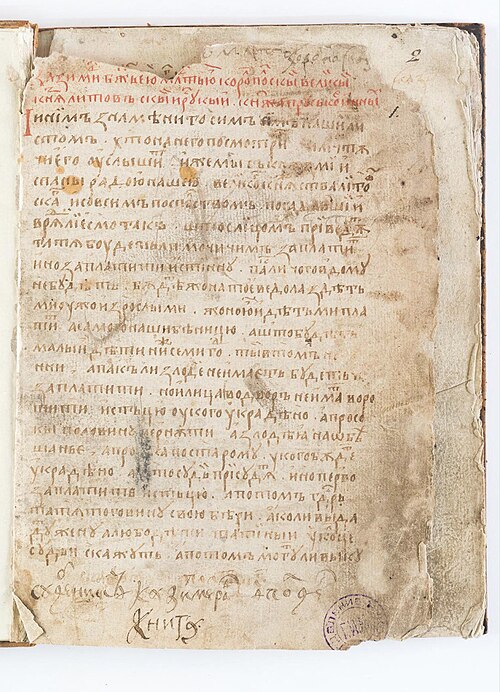
The Casimir's Code of 1468, in Ruthenian

The third Lithuanian statute of 1588, all three written in Ruthenian

Ruthenian Bible by Francysk Skaryna, 1517, first ever book printed in Eastern Europe