Biblical Magi
Videos
In Christianity, the Biblical Magi, also known as the Three Wise Men, Three Kings, and Three Magi, are distinguished foreigners who visit the infant Jesus after his birth, bearing gifts of gold, frank
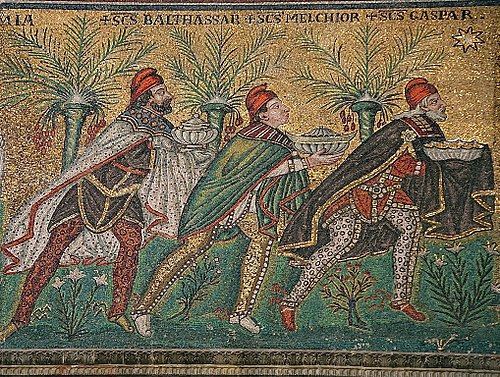
The Three Magi, Byzantine mosaic, c. 565, Basilica of Sant'Apollinare Nuovo, Ravenna, Italy (restored during the 19th century). As here, Byzantine art usually depicts the Magi in Persian clothing, which includes breeches, capes, and Phrygian caps.

Biblical Magi stained glass window, c. 1896, at the Church of the Good Shepherd (Rosemont, Pennsylvania), showing the Three Magi with Joseph, Mary, and Jesus.

Incised third century A.D. sarcophagus slab depicts the Adoration of the Magi, from the Catacombs of Rome – translated as, "Severa, may you live in God", Severa being the woman buried in the sarcophagus and likely the figure to the left of the inscription.

The three Magi (named Balthazar, Caspar, and Melchior), from Herrad of Landsberg's Hortus deliciarum (12th century)
Balthazar (magus)
Videos
Balthazar, also called Balthasar, Balthassar, and Bithisarea, was, according to Western Christian tradition, one of the three biblical Magi along with Caspar and Melchior who visited the infant Jesus
Biblical Magi
…Caspar ( or ; also Gaspar, Jaspar, Jaspas, Gathaspa, and other variations). Balthazar ( or ; also Balthasar, Balthassar, and Bithisarea). These names first appear in an eighth-century religious chronicle, Excerpta Latina Barbari, which…

Detail of Balthazar in Adoration of the Kings by Gerard David, c. 1515

Hans Memling painted Balthazar in 1470 wearing ermine fur and holding a gift in the form of a covered beaker

By the 1490s this gift was often in the shape of a horn

Pieter Coecke van Aelst painted Balthazar in 1530 with a similar horn beaker