Biology in fiction
Videos
Biology appears in fiction, especially but not only in science fiction, both in the shape of real aspects of the science, used as themes or plot devices, and in the form of fictional elements, whether
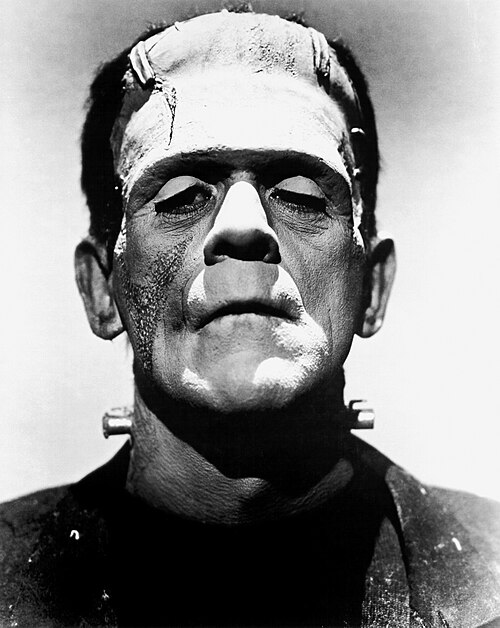
Boris Karloff in James Whale's 1931 film Frankenstein, based on Mary Shelley's 1818 novel. The monster is created by an unorthodox biology experiment.

Jack London's 1912 The Scarlet Plague (reprinted in 1949) takes place after an uncontrollable epidemic.

Naomi Alderman's 2016 novel The Power imagines that women have electric organs like those of the electric eel, Electrophorus electricus, creating powerful electric fields with modified muscles. The pits along the electric eel's body are lateral line organs, used to detect prey by sensing small vibrations.

A 1990s gargoyle at Paisley Abbey resembling a Xenomorph parasitoid from Alien
Genetics
Videos
Genetics is the study of genes, genetic variation, and heredity in organisms. It is an important branch in biology because heredity is vital to organisms' evolution. Gregor Mendel, a Moravian Augustin
Portrait of Imre Festetics, the first geneticist and ethologist. His concepts of selection and evolution were later formulated in Charles Darwin's theory of evolution.


Walther Flemming's 1882 diagram of eukaryotic cell division. Chromosomes are copied, condensed, and organized. Then, as the cell divides, chromosome copies separate into the daughter cells.

Siamese cats have a temperature-sensitive pigment-production mutation.