Bishop Dunbar's Hospital was founded in 1531 by Bishop Gavin Dunbar, the Elder. The hospital was endowed by a mortification just before his death. Dunbar petitioned the King, James V of Scotland, and the charter, signed on 24 February 1531 records the King’s approval that ‘[Dunbar shall] ... found an hospital near the cathedral church, but outside the cemetery...’ It was also known as St Mary's Hospital. In the mortification, Dunbar's charitable purpose is recorded. Bedesmen were supported by a charitable foundation that emerged from the original church control until the twenty-first century. Bedesmen drew their name from the word "bede" - a prayer. The residents of Dunbar's Hospital said prayers in a cycle of Divine Office. The Bede House, Old Aberdeen was used by the Bedesmen from the hospital from 1789 to the end of the nineteenth century. The only remains of the 1531 building can be seen in a perimeter wall for Seaton Park in Old Aberdeen. The last Bedesman died in 1988. The Managers of the Hospital constituted a Charity, Bishop Dunbar Hospital Trust. The Charity ceased active operation in 2012.

Sketch of Dunbar's Hospital: from Alexander Macdonald Munro, and New Spalding Club (Aberdeen Scotland), Records of Old Aberdeen, Mclvii-Mdcccxci (Mcccxcviii-Mcmiii) Vol. 2. (Aberdeen: Printed for the New Spalding Club, 1899). - Unknown author.
The Beginning of the 1531 Charter from James V to Bishop Dunbar (in the University of Aberdeen Archives)
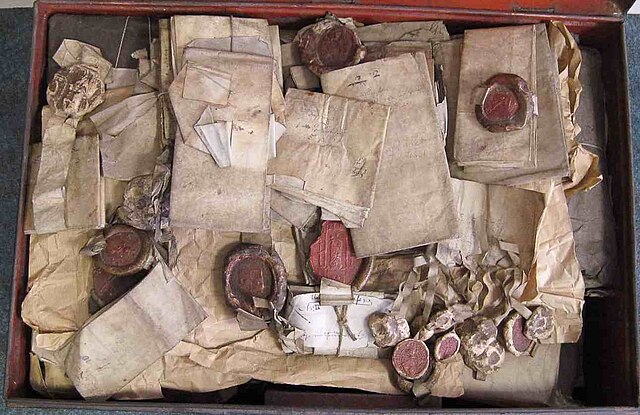
The Manuscripts, seals, and assorted papers covering the period 1531 to 1900. A catalogue of the archive is held by the University of Aberdeen.
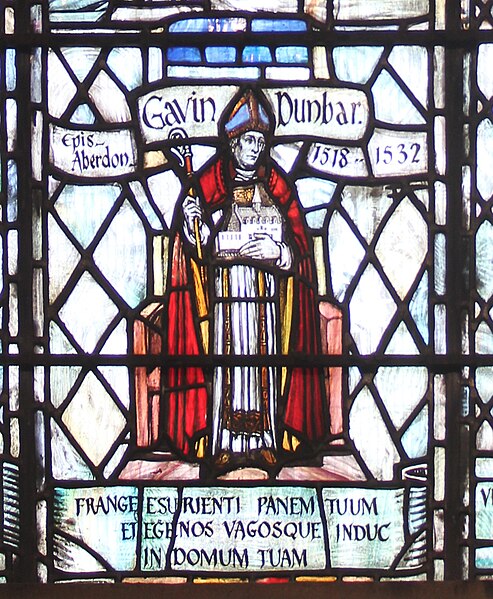
Bishop Gavin Dunbar - holding a "model" of St Mary's hospital ( 1531). From the "Dorcas" window in the Cathedral Church of St Machar, Old Aberdeen. The text "FRANGE ESURIENTI PANEM TUUM ET EGENOS VAGOSQUE INDUC IN DOMUM TUAM" [ ...give thy bread to the hungry and the needy and bring the wandering into your house...] comes from the Foundation Charter. (quote from The Bible (King James) Acts 9:36 & Isaiah 58:7)
The Bede House in Old Aberdeen, Scotland, is a 17th-century Scottish town house. It was built in 1676 as a residence for Bailie William Logan and his wife Jean Moir of Stoneywood. During the late 18th century, Old Aberdeen Bedesmen moved from their original hospital beside St Machar's Church to the former Logan house in Don Street. In the 19th century the house changed hands. It was first owned by the Burgh of Old Aberdeen, then, by the City of Aberdeen after the merger of the two burghs in 1891. The house was refurbished by the City of Aberdeen Council in 1965. It was divided into two flats or apartments. The flats are now in private ownership. Much of the 17th-century building is in its original form. It is an excellent example of an L-shaped Scottish Town House, built on three floors with an attic. The house is designated as a Category A listed building.
Bede House, Old Aberdeen, 1676