Blaže Koneski
Videos
Blaže Koneski was a Macedonian poet, writer, literary translator, and linguistic scholar, who had a major contribution to the codification of the standard Macedonian language, for which he earned the
Koneski in 1968


Blaže Koneski's house in his birthplace, now a memorial house

Monument of Koneski in front of the Macedonian Academy of Sciences and Arts in Skopje

Statue of Koneski on the Art Bridge in Skopje
Historiography in North Macedonia is the methodology of historical studies developed and employed by Macedonian historians. It traces its origins to the 1940s, when SR Macedonia became part of Yugosla
Blaže Koneski
…In turn, they were accused of Bulgarophilia and Serbophobia. By the early 1990s, the right-wing media also made such accusations. From the 1990s, Macedonian historical revisionists, who questioned the narrative established in Communist Yugoslavia, have described the process of codifying Macedonian, to which Koneski was an important…

The Bitola inscription from 1016/1017. Originally exhibited in the local museum, it was locked away when Bulgarian scientists became aware of its content, confirming the Cometopuli considered their state Bulgarian.
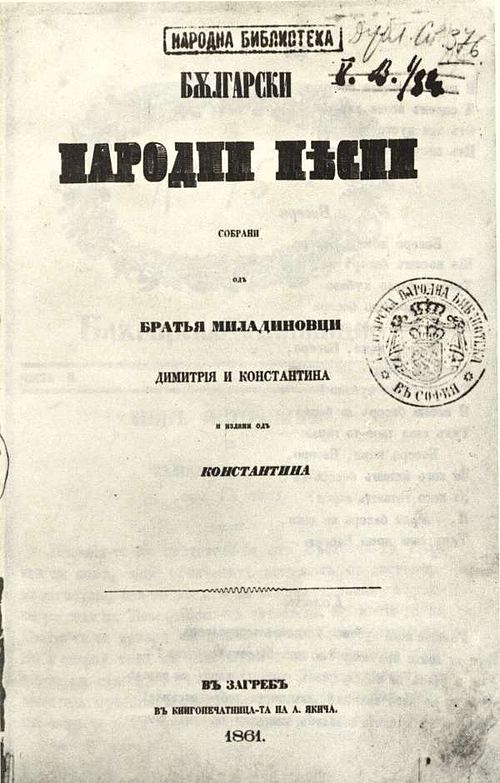
Front cover of the Bulgarian Folk Songs collected by the Miladinov Brothers and published in 1861. In the early 2000s the Macedonian State Archive displayed a photocopy of the book, but with the upper part showing the word "Bulgarian" being cut off.

The statute of the turn of the 20th century Bulgarian Macedonian-Adrianople Revolutionary Committees (later IMARO/IMRO). Its membership then was allowed only for Bulgarians. It was discovered by Ivan Katardžiev in Skopje, but its authenticity has been disputed by most Macedonian historians.

Bulgarian invasion in Vardar Banovina, April 1941. Bulgarians were greeted as liberators as an effect from the previous oppressive Serbian rule. In many places celebrations were organized by the Bulgarian Action Committees. The local communists then joined the BCP and refused any military actions against the Bulgarians in the beginning. However, after the initial phase, the Bulgarian regime launched an oppressive Bulgarisation campaign, with whom they turned the population strongly against them, and the communist resistance grew as well.