Black Death
Videos
The Black Death was a plague pandemic that occurred in Europe from 1346 to 1353. It was one of the most fatal pandemics in human history, leading to the death of up to 50 million people, around 30% to

Yersinia pestis (200 × magnification), the bacterium that causes plague

The Oriental rat flea (Xenopsylla cheopis) engorged with blood. This species of flea is the primary vector for the transmission of Yersinia pestis, the organism responsible for spreading bubonic plague in most plague epidemics. Both male and female fleas feed on blood and can transmit the infection.

Oriental rat flea (Xenopsylla cheopis) infected with the Yersinia pestis bacterium which appears as a dark mass in the gut. The foregut (proventriculus) of this flea is blocked by a Y. pestis biofilm; when the flea feeds on an uninfected host Y. pestis is regurgitated into the wound, causing infection.
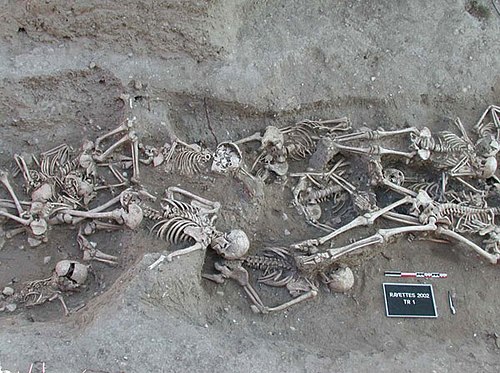
Skeletons in a mass grave from 1720 to 1721 in Martigues, near Marseille in southern France, yielded molecular evidence of the orientalis strain of Yersinia pestis, the organism responsible for bubonic plague. The second pandemic of bubonic plague was active in Europe from 1347, the beginning of the Black Death, until 1750.
Second plague pandemic
Videos
The second plague pandemic was a major series of epidemics of plague that started with the Black Death, which reached medieval Europe in 1346 and killed up to half of the population of Eurasia in the
Black Death
…through respiratory droplets. The Black Death had far-reaching population, economic, and cultural effects. It has been tentatively considered as the second plague pandemic, despite each of these outbreaks being separated by around 500–600 years. The Black Death was the second great natural disaster to strike Europe during…

Great Plague of London in 1665

Plague Column in Vienna was erected after the Great Plague epidemic in 1679

The Great Plague of Marseille in 1720 killed 100,000 people in the city and the surrounding provinces.

Contemporary engraving of Naples during the Naples Plague in 1656