Black hole
Videos
A black hole is an astronomical body so compact that its gravity prevents anything, including light, from escaping. Albert Einstein's theory of general relativity, which describes gravitation as the c
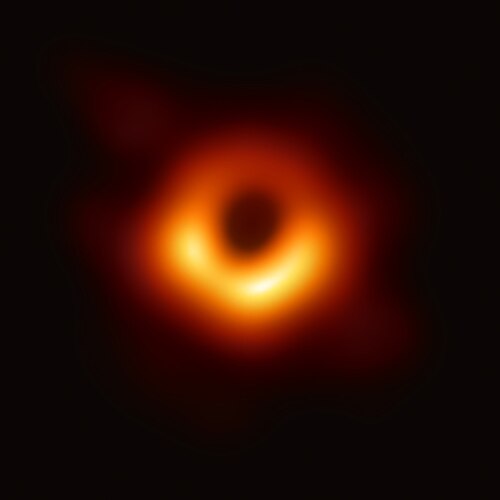
An image of the core region of Messier 87, a supermassive black hole, processed from an array of eight radio telescopes known as the EHT with colours indicating brightness temperature

The first simulated image of a black hole, published by Jean-Pierre Luminet in 1979 and featuring the characteristic shadow, photon sphere, and lensed accretion disk. The disk is brighter on one side due to Doppler beaming.

Image by the Event Horizon Telescope of the supermassive black hole in the centre of Messier 87

Relativistic jets from the supermassive black hole in Centaurus A extend perpendicularly from the galaxy.
Event horizon
Videos
In astrophysics, an event horizon is a boundary in spacetime beyond which no signal can ever reach a given observer. Wolfgang Rindler coined the term in the 1950s.
Black hole
…gravitation as the curvature of spacetime, predicts that any sufficiently compact mass will form a black hole. The boundary of no escape is called the event horizon. In general relativity, crossing a black hole's event horizon traps an object inside but produces no locally detectable change. General relativity also…

As the camera approaches the event horizon, the view of the outside universe appears to contract ahead while the shadow grows beneath.

Inside of the event horizon the roles of space and time switch. The singularity becomes an inevitable moment in the future and conversely the event horizon becomes a moment in the past. The black hole shadow approaches half the field of view, while simultaneously the aberration of light (due to exponentially-increasing tidal forces) concentrate the view of the outside universe into a thin band. In the final moments, all views of the outside universe eventually pinch off into total darkness.