Bolivia
Videos
Bolivia, officially the Plurinational State of Bolivia, is a landlocked country located in central South America. Its geography primarily consists of an Andean region to the west and tropical lowlands
![The Kalasasaya Temple of the Tiwanaku Polity (200 BC)[page needed]](https://upload.wikimedia.org/wikipedia/commons/thumb/f/f6/Templo_de_Kalasasaya%2C_Tiwanaku.jpg/500px-Templo_de_Kalasasaya%2C_Tiwanaku.jpg)
The Kalasasaya Temple of the Tiwanaku Polity (200 BC)[page needed]

The Villa Imperial de Potosí, established in 1545, held great significance for the Spanish colonial empire, as its abundant mineral wealth accounted for over half of the global silver production during the colonial period.
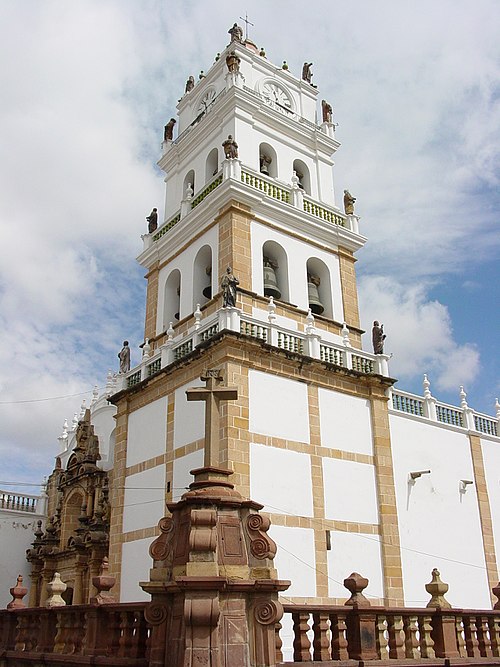
Metropolitan Cathedral of Sucre in Sucre, a UNESCO World Heritage city

Historic headquarters of Banco Nacional de Bolivia in Sucre
Rodrigo Paz
Videos
Rodrigo Paz Pereira is a Bolivian politician and diplomat who has served as the 68th president of Bolivia since 2025. The eldest son of former president Jaime Paz Zamora and great-nephew of president
Bolivia
…coup attempt led by Juan José Zúñiga ended after lasting only 5 hours. In the evening of 26 June, Bolivian police arrested Zúñiga. In October 2025, Rodrigo Paz of the centre-right Christian Democratic Party (PDC) won the run-off race of the election against right-wing former president Jorge Quiroga, meaning…

Paz in 2026

Paz's official portrait as senator in 2020

Argentine president Javier Milei with Paz on the latter's inauguration, 8 November 2025

Paz with Brazilian President Luiz Inácio Lula da Silva, 13 March 2026