Book of the Dead
Videos
The Book of the Dead is the name given to an ancient Egyptian funerary text generally written on papyrus and used from the beginning of the New Kingdom to around 50 BC. "Book" is the closest term to d

This detailed scene, from the Papyrus of Hunefer (c. 1275 BC), shows the scribe Hunefer's heart being weighed on the scale of Maat against the feather of truth, by the jackal-headed Anubis. The ibis-headed Thoth, scribe of the gods, records the result. If his heart equals exactly the weight of the feather, Hunefer is allowed to pass into the afterlife. If not, he is eaten by the waiting chimeric devouring creature Ammit composed of the deadly crocodile, lion, and hippopotamus. Vignettes such as these were a common illustration in Egyptian books of the dead.

The entire Papyrus of Ani. (Scroll left or right.)

Part of the Pyramid Texts, a precursor of the Book of the Dead, inscribed on the tomb of Teti
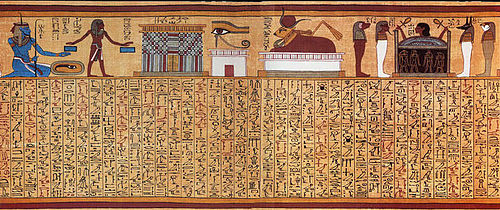
The mystical Spell 17, from the Papyrus of Ani. The vignette at the top illustrates, from left to right, the god Nu as a representation of the primordial ocean; a gateway to the realm of Osiris; the Eye of Horus; the celestial cow Mehet-Weret; and a human head rising from a coffin, guarded by the four Sons of Horus.
Duat
Videos
The Duat or Tuat is a concept in ancient Egyptian mythology involving death. It is most often seen as a realm where people go after they die. Due to linguistic shifts within Ancient Egypt, the Duat ha
Book of the Dead
…closest term to describe the loose collection of texts consisting of a number of magic spells intended to assist a dead person's journey through the Duat, or underworld, and into the afterlife and written by many priests over a period of about 1,000 years. In 1842, the Egyptologist Karl Richard Lepsius…
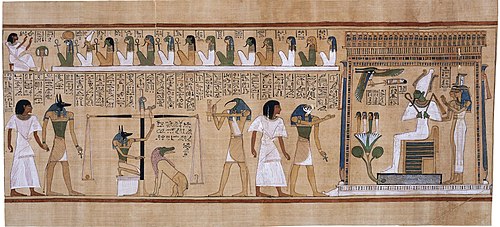
The 'Weighing of the Heart' from the Book of the Dead from the Papyrus of Hunefer, dated to the 19th Dynasty around 1275 BCE. The deceased Hunefer is taken into the judgment hall by the deity Anubis, who weighs a portion of Hunefer's soul, represented by his heart. This ritual is completed with Ammit the Devourer awaiting the result, and Thoth recording. Next, the triumphant Hunefer, having passed the test, is presented by the falcon-headed Horus to

A'aru, 'The Field of Reeds' from the Papyrus of Ani

The 42 Judges of Ma'at who sit as jury during the 'Weighing of the Heart'

Af or Afu (commonly known as Afu-Ra), the ram-headed form of Ra when traveling the Duat on the subterrestrial Nile (the 12 hours of night and the underworld) on the Mesektet barque along with Sia (left and front of barque) and Heka (right and behind of barque), surrounded by the protective coiled serpent deity Mehen