Boston Tea Party
Videos
The Boston Tea Party was an act of protest on December 16, 1773, during the American Revolution. Initiated by the Sons of Liberty in Boston, the capital of Massachusetts, one of the Thirteen Colonies

Boston Tea Party, an engraving in The History of North America, a 1799 book by William Cooper
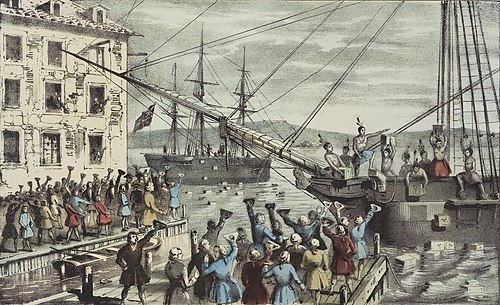
The Destruction of Tea at Boston Harbor, an iconic 1846 lithograph by Nathaniel Currier; the phrase "Boston Tea Party" had not yet become standard. Contrary to Currier's depiction, few of the men dumping the tea were actually disguised as American Indians.

A 1775 British cartoon, A Society of Patriotic Ladies at Edenton in North Carolina, satirizing the Edenton Tea Party, a group of American women who organized a boycott of British tea

A notice from the "Chairman of the Committee for Tarring and Feathering" in Boston, denouncing the tea consignees as "traitors to their country"
Sons of Liberty
Videos
The Sons of Liberty was a loosely organized, clandestine, sometimes violent, political organization active in the Thirteen American Colonies founded to defend the rights of the colonists, including th
Boston Tea Party
…The Boston Tea Party was an act of protest on December 16, 1773, during the American Revolution. Initiated by the Sons of Liberty in Boston, the capital of Massachusetts, one of the Thirteen Colonies of British America, it escalated tensions between Great Britain and the Patriots…

A 1765 handbill, announcing an upcoming "Sons of Liberty" public event

The Bostonian Paying the Excise-Man, 1774 British anti-American propaganda cartoon, referring to the tarring and feathering of Boston Commissioner of Customs John Malcolm four weeks after the Boston Tea Party. The men also are shown pouring "Tea" down Malcolm's throat; note the noose hanging on the Liberty Tree and the Stamp Act posted upside-down.

1st row: Samuel Adams • Benedict Arnold • John Hancock • Patrick Henry • James Otis, Jr. 2nd row: Paul Revere • James Swan • Alexander McDougall • Benjamin Rush • Charles Thomson 3rd row: Joseph Warren • Marinus Willett • Oliver Wolcott • Christopher Gadsden • Haym Salomon Not pictured: Hercules Mulligan, Thomas Melvill, Isaac Sears

Isaac Barré's use of the term "Sons of Liberty" during his opposition to the Stamp Act popularized it.