Bridge
Videos
A bridge is a structure designed to span an obstacle, such as a river or railway, allowing vehicles, pedestrians, and other loads to pass across. Most bridges consist of a flat deck, supported by beam
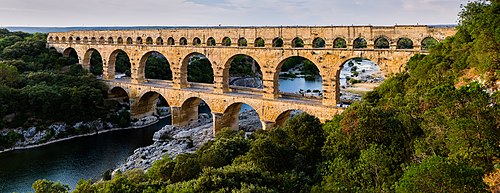
The Pont du Gard aqueduct in France was built by the Roman Empire c. 40–60 AD.

The Anji Bridge, which uses a shallow segmental arch, was built in China c. 600 AD.

The Rialto Bridge, built in 1591, crosses the Grand Canal in Venice.

The mass production of steel enabled the construction of large suspension bridges. The Brooklyn Bridge, built in the 1870s, was the first suspension bridge to use steel for its cables.
Truss bridge
Videos
A truss bridge is a bridge whose load-bearing superstructure is composed of a truss, a structure of connected elements, usually forming triangular units. The connected elements, typically straight, ma
Bridge
…primarily of concrete or steel. With the Industrial Revolution came mass-produced steel, which enabled the creation of more complex forms – including truss and cantilever bridges – that permitted bridges to cross wide rivers or deep valleys. The longest spans use suspension or cable-stayed designs, both…

A truss bridge operated by Southern Pacific Railroad in Contra Costa County, California, converted to pedestrian use and pipeline support

A railway bridge with a rail track in Leflore County, Mississippi

Pratt through truss of the former Seaboard Air Line Railway, located near Willow, Florida; abandoned since the mid-1980s

Deck truss railroad bridge over the Erie Canal in Lockport, New York