Brown dwarf
Videos
Brown dwarfs are substellar objects that have more mass than the biggest gas giant planets, but less than the least massive main-sequence stars. Their mass is approximately 13 to 80 times that of Jupi

Artist's concept of a T-type brown dwarf
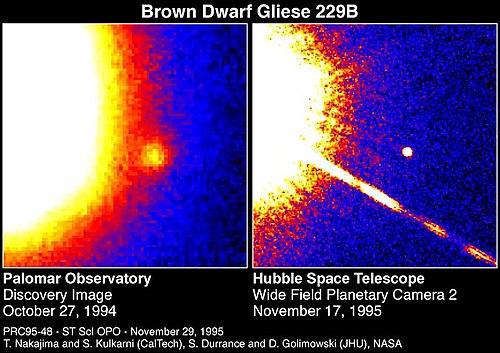
The smaller object is Gliese 229B, about 20 to 50 times the mass of Jupiter, orbiting the star Gliese 229. It is in the constellation Lepus, about 19 light-years from Earth.

Planets, brown dwarfs, stars (not to scale)

A size comparison between the Sun, a young sub-brown dwarf, and Jupiter. As the sub-brown dwarf ages, it will gradually cool and shrink.
Rogue planet
Videos
A rogue planet, also termed a free-floating planet or an isolated planetary-mass object, is an interstellar object of planetary mass which is not gravitationally bound to any star or brown dwarf.
Brown dwarf
…have masses below 13 MJ, and as a result are sometimes referred to as planetary-mass objects due to the ambiguity of whether they should be regarded as rogue planets or brown dwarfs. There are planetary-mass objects known to orbit brown dwarfs, such as 2M1207b, 2MASS J044144b and Oph 98 B. The 13-Jupiter-mass cutoff…

115 potential rogue planets in the region between Upper Scorpius and Ophiuchus (2021)

The cold planetary-mass object WISE J0830+2837 (marked orange object) observed with the Spitzer Space Telescope. It has a temperature of 300–350 K (27–77 °C; 80–170 °F).

JuMBO 29, a candidate 12.5+3 MJ binary, separated by 135 AU, located in the Orion Nebula

Artist's conception of a Jupiter-size rogue planet