Buddhism and science
Videos
The relationship between Buddhism and science is a subject of contemporary discussion and debate among Buddhists, scientists, and scholars of Buddhism. Historically, Buddhism encompasses many types of

Ruins of Nālandā University

Parliament of the World's Religions, Chicago, United States, 1893.
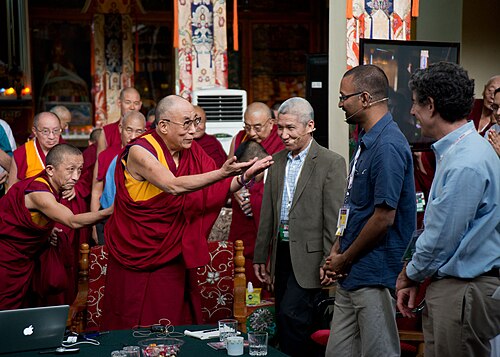
Rajesh Kasturirangan with the 14th Dalai Lama, Geshe Thupten Jinpa and Richard Davidson at Mind and Life Institute XXVI conference, 2013

The classical Buddhist understanding of life includes karma and rebirth (depicted here in a Tibetan "wheel of existence").
Buddhist philosophy
Videos
Buddhist philosophy is the ancient Indian philosophical system that developed within the religio-philosophical tradition of Buddhism. It comprises all the philosophical investigations and systems of r

The Buddhist Nalanda mahāvihāra (great monastery) was a major institution of higher-learning in ancient India from the 5th century CE until the 12th century.

Gautama Buddha surrounded by his followers. Illustration from an 18th-century Burmese watercolour, Bodleian Library.

Indian Emperor Aśoka and the elder Moggaliputta-Tissa, who is seen as a key thinker of the Vibhajyavāda tradition (and thus, of Theravada).

The world's earliest printed book is a Chinese translation of the Vajracchedikā Prajñāpāramitā Sūtra ("Diamond-Cutter Sūtra") from Dunhuang (c. 868 CE).