Burroughs Large Systems
Videos
Photos
The Burroughs Large Systems Group produced a family of large 48-bit mainframes using stack machine instruction sets with dense syllables. The first machine in the family was the B5000 in 1961, which was optimized for compiling ALGOL 60 programs extremely well, using single-pass compilers. The B5000 evolved into the B5500 and the B5700. Subsequent major redesigns include the B6500/B6700 line and its successors, as well as the separate B8500 line.

Figure 4.5 From the ACM Monograph in the References. Elliot Organick 1973.

Figure 9.2 From the ACM Monograph in the References. Elliot Organick 1973.
Mainframe computer
Videos
Photos
A mainframe computer, informally called a mainframe or big iron, is a computer used primarily by large organizations for critical applications like bulk data processing for tasks such as censuses, industry and consumer statistics, enterprise resource planning, and large-scale transaction processing. A mainframe computer is large but not as large as a supercomputer and has more processing power than some other classes of computers, such as minicomputers, servers, workstations, and personal computers. Most large-scale computer-system architectures were established in the 1960s, but they continue to evolve. Mainframe computers are often used as servers.

A single-frame IBM z15 mainframe. Larger capacity models can have up to four total frames. This model has blue accents, as compared with the LinuxONE III model with orange highlights.

A pair of IBM mainframes. On the left is the IBM z Systems z13. On the right is the IBM LinuxONE Rockhopper.
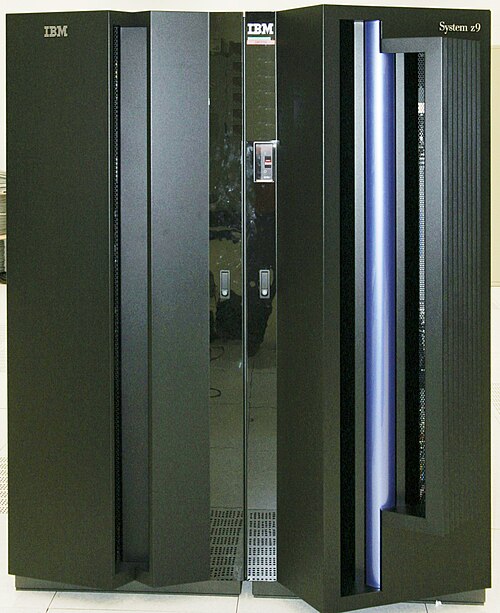
An IBM System z9 mainframe

Inside an IBM System z9 mainframe