Byōbu
Videos
Byōbu are Japanese folding screens made from several joined panels, bearing decorative painting and calligraphy, used to separate interiors and enclose private spaces, among other uses.

A six-panel byōbu from the 17th century

Left panel of Irises (燕子花図, kakitsubata-zu) by Ogata Kōrin, 1702
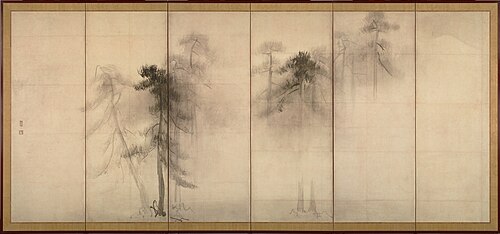
Left panel of the Shōrin-zu byōbu (松林図 屏風, Pine Trees screen) by Hasegawa Tōhaku, c. 1595

Byōbu depicting Osaka from the early 17th century in Eggenberg Castle in Graz
Sudare
Videos
Sudare are traditional Japanese screens or blinds, made of horizontal slats of decorative wood, bamboo, or other natural material, woven together with simple string, colored yarn, or other decorative
Byōbu
…Noren (textile doorhanging) Sudare (reed blind) Japanese Architecture and Art Net Users System Byoubu entry…

The writer Sei Shōnagon standing behind a misu

Misu protecting the view to the Imperial throne in the Shishin-den of Kyoto Imperial Palace

Less formal (but still cloth-bound) sudare in a common home; from the more brightly-lit side, they are opaque

Sudare on a train; from the more dimly-lit side, they are transparent