The Byzantine Empire was ruled by emperors of the dynasty of Heraclius between 610 and 711. The Heraclians presided over a period of cataclysmic events that were a watershed in the history of the Empire and the world. Heraclius, the founder of his dynasty, was of Armenian and Cappadocian (Greek) origin. At the beginning of the dynasty, the Empire's culture was still essentially Ancient Roman, dominating the Mediterranean and harbouring a prosperous Late Antique urban civilization. This world was shattered by successive invasions, which resulted in extensive territorial losses, financial collapse and plagues that depopulated the cities, while religious controversies and rebellions further weakened the Empire.

The Byzantine Empire after Heraclius reconquered the Eastern Provinces from the Sassanids.

Solidus of Heraclius' reign, showing his son Constantine III as co-emperor.

The Arsanias River, now known as the Murat River in modern Turkey.
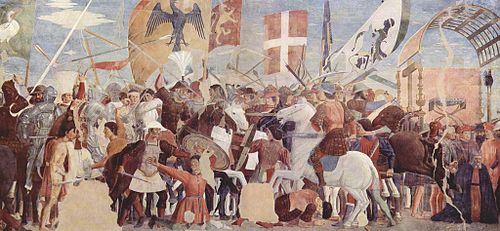
Battle between Heraclius and the Persians. Fresco by Piero della Francesca, c. 1452
Heraclius the Elder
Videos
Heraclius the Elder was a Byzantine general and the father of Byzantine emperor Heraclius. Generally considered to be of Armenian origin, Heraclius the Elder distinguished himself in the war against the Sassanid Persians in the 580s. As a subordinate general, Heraclius served under the command of Philippicus during the Battle of Solachon and possibly served under Comentiolus during the Battle of Sisarbanon. Circa 595, Heraclius the Elder is mentioned as a magister militum per Armeniam sent by Emperor Maurice to quell an Armenian rebellion led by Samuel Vahewuni and Atat Khorkhoruni. Circa 600, he was appointed as the Exarch of Africa and in 608, he rebelled with his son against the usurper Phocas. Using North Africa as a base, the younger Heraclius managed to overthrow Phocas, beginning the Heraclian dynasty, which would rule Byzantium for a century. Heraclius the Elder died soon after receiving news of his son's accession to the Byzantine throne.

Gold solidus struck during the revolt of the Heraclii, depicting Heraclius the Elder and his son, the future Emperor Heraclius, wearing consular robes.