Throughout the fifth century, Hellenistic-Eastern political systems, philosophies, and theocratic Christian concepts had gained power in the Greek-speaking Eastern Mediterranean due to the interventio
Painting of Emperor Basil II in triumphal garb, exemplifying the imperial diadem and royal power handed down by Christ and the angels.


The back of this coin by Manuel I Comnenus bears his title, porphyrogennetos.

Emperor Manuel II Palaiologos with his family: empress Helena Dragaš (right), and three of their sons, John, Andronikos and Theodore. John, as his father's heir and co-emperor, wears an exact replica of his imperial costume.
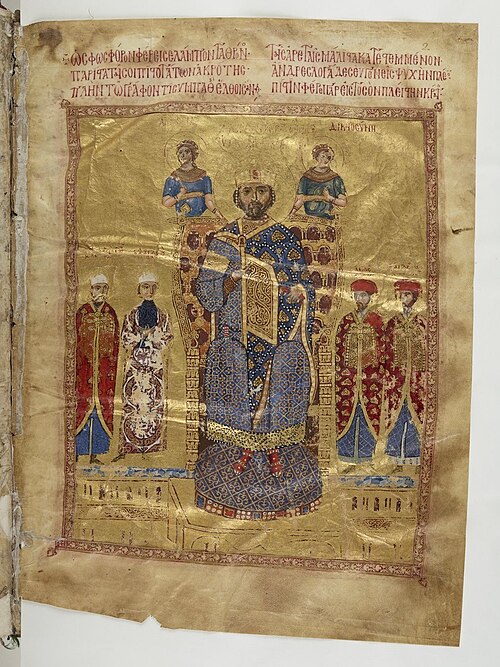
Emperor Nikephoros III with an aura flanked by personifications of Truth and Justice, and by his senior court dignitaries, from an illuminated manuscript dating to the 1070s. From left: the proedros and epi tou kanikleiou, the prōtoproedros and prōtovestiarios (a eunuch, since he is beardless), the emperor, the proedros and dekanos, and the proedros and megas primikērios.
Exarch
Videos
An exarch is an official in various jurisdictions both historical and modern.
Byzantine bureaucracy and aristocracy
…standardized and often mandatory. In practice, imperial power was exercised as administration—simplified and centralized through viceroys such as the Exarchos, Douk, Katepánō, Kephalai and the Strategoi who enjoyed the same omnipotence and the emperor's God given dignity in their respective governorships…

Georgian Exarchate in the 19th century

Metropolitan Platon (Rozhdestvensky), last Exarch of Georgia (1915–1917) and first Exarch of Caucasus (1917–1918)

Gesupietrochiave