Caecilia gens
Videos
The gens Caecilia was a plebeian family at ancient Rome. Members of this gens are mentioned in history as early as the fifth century BC, but the first of the Caecilii who obtained the consulship was Lucius Caecilius Metellus Denter, in 284 BC. The Caecilii Metelli were one of the most powerful families of the late Republic, from the decades before the First Punic War down to the time of Augustus.

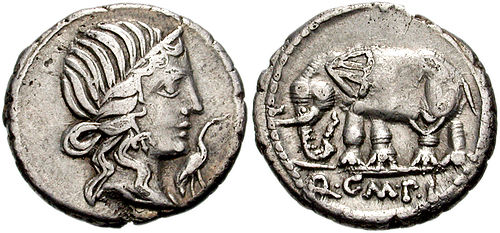
Denarius of Quintus Caecilius Metellus Pius, 81 BC. The obverse depicts a head of Pietas, alluding to the agnomen, Pius. The elephant on the reverse commemorates the capture of Carthaginian elephants by Lucius Caecilius Metellus at Panormus in 251 BC.
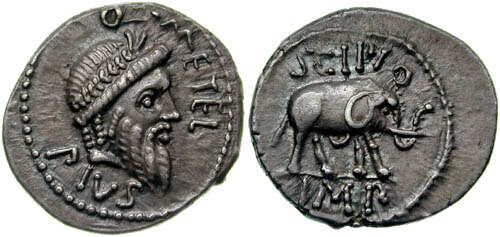
Denarius of Quintus Caecilius Metellus Pius Scipio, c. 46 BC. The obverse depicts the head of Jupiter. The elephant on the reverse may also allude to Africa, since the coin was minted there before the Battle of Thapsus.

Denarius of Gaius Caecilius Metellus Caprarius, 125 BC. The reverse depicts the triumph of his ancestor Lucius Caecilius Metellus, with the elephants he had captured at the Battle of Panormus.
Quintus Caecilius Iucundus
Videos
Quintus Caecilius Iucundus was the son of Lucius Caecilius Iucundus, a banker who lived in the Roman town of Pompeii around AD 14–62.

The House of Lucius Caecilius Iucundus in Pompeii, where Quintus Caecilius Iucundus lived. An inscription of his name upon the wall is the only known attestation of his name.