Cai Lun
Videos
Cai Lun, formerly romanized as Ts'ai Lun, was a Chinese eunuch court official of the Eastern Han dynasty. He occupies a pivotal place in the history of paper due to his addition of pulp via tree bark
Qing-era print depicting Cai as the patron of papermaking, 18th century


The Three Gods of Paper-making, Cai Lun (in the middle) with the Korean monk Damjing (on the left), who brought the art to Japan, and Mochizuki Seibei (who brought the art to Nishijima (西嶋)). Kept in the Minobu Town Museum of History and Folklore.
![Cai Lun's traditional tomb, Longting [zh], Hanzhong, Shaanxi Province.](https://upload.wikimedia.org/wikipedia/commons/thumb/b/bf/Cai_Lun%27s_Tomb.jpg/500px-Cai_Lun%27s_Tomb.jpg)
Cai Lun's traditional tomb, Longting [zh], Hanzhong, Shaanxi Province.

CMOC Treasures of Ancient China exhibit painted figure of a cavalryman, horse detail
Paper
Videos
Paper is a thin sheet of matted cellulose fibers. Largely derived from lignocellulose, paper is created from a pulp dissolved into a slurry that is drained and dried into sheets. Different types of pa
Cai Lun
…tree bark and hemp ends which resulted in the large-scale manufacture and worldwide spread of paper. Although traditionally regarded as the inventor of paper, earlier forms of paper have existed since the 3rd century BCE, so Cai's contributions were an innovation, rather than an invention. Born in Guiyang…

Paper products: book, toilet paper, ruled paper, carton, egg carton
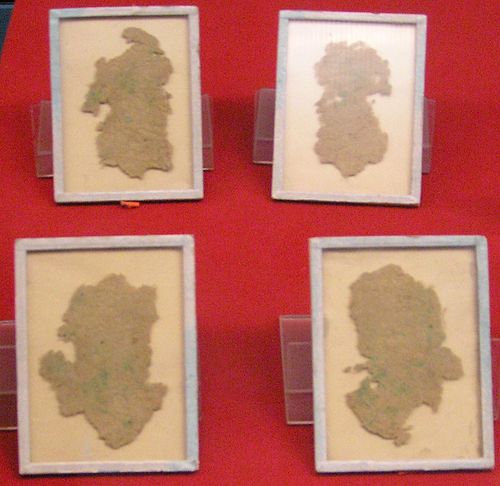
Hemp wrapping paper, China, c. 100 BCE

The microscopic structure of paper: Micrograph of tissue paper autofluorescing under ultraviolet illumination. The individual fibres in this sample are around 10 μm in diameter.

Paper mill in Mänttä-Vilppula, Finland