Callophrys hesseli
Videos
Callophrys hesseli, or Hessel's hairstreak, is a butterfly of the family Lycaenidae. It ranges from southern Maine south along the Atlantic coastal plain to the Florida Panhandle on the Gulf Coast. Th

Callophrys hesseli
Animal coloration provided important early evidence for evolution by natural selection, at a time when little direct evidence was available. Three major functions of coloration were discovered in the
Callophrys hesseli
…The caterpillars evolved to blend in perfectly with the foliage of the trees which mainly consists of scaly green leaves with bright highlights. The coloration adaptations continue into adulthood in which the Hessel's Hairstreak, when at rest, reveals the underside of its wings which have a brown background…

Natural selection has driven the ptarmigan to change from snow camouflage in winter to disruptive coloration suiting moorland in summer.
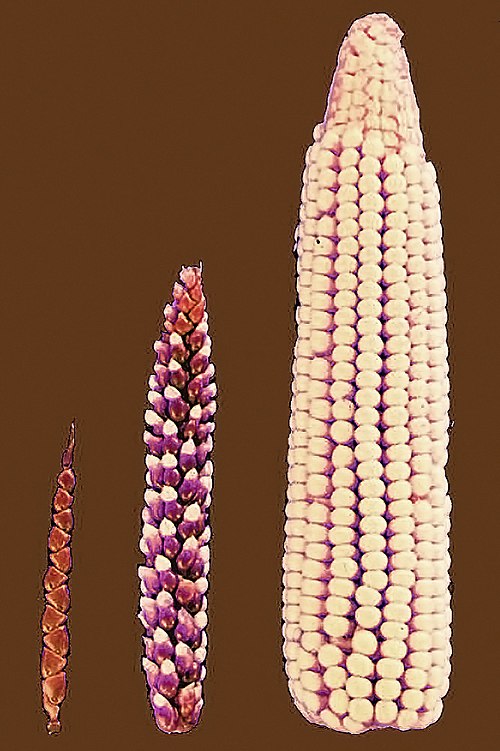
Selective breeding transformed teosinte's small spikes (left) into modern maize (right). Darwin argued that evolution worked in a similar way.

Convergent evolution of snow camouflage in Arctic hare, ermine, and ptarmigan provided early evidence for natural selection.

Hugh Cott's drawings of 'coincident disruptive coloration' formed "persuasive arguments" for natural selection. Left: active; right: at rest, marks coinciding.