Camel
Videos
A camel is an even-toed ungulate in the genus Camelus that bears distinctive fatty deposits known as "humps" on its back. Camels have long been domesticated and, as livestock, they provide food and te
07. Camel Profile, near Silverton, NSW, 07.07.2007


Camelus bactrianus

Camel humps store fat for when food is scarce. If a camel uses the fat, the hump becomes limp and droops.

A camel's thick coat is one of its many adaptations that aid it in desert-like conditions.
Wild Bactrian camel
Videos
The wild Bactrian camel or simply the wild camel is an endangered species of camel endemic to Northwest China and southwestern Mongolia. It is closely related but not ancestral to the domestic Bactria
Camel
…surviving species of camel. The one-humped dromedary makes up 94% of the world's camel population, and the two-humped Bactrian camel makes up 6%. The wild Bactrian camel is a distinct species that is not ancestral to the domestic Bactrian camel, and is now critically endangered, with fewer than 1,000 individuals. The…
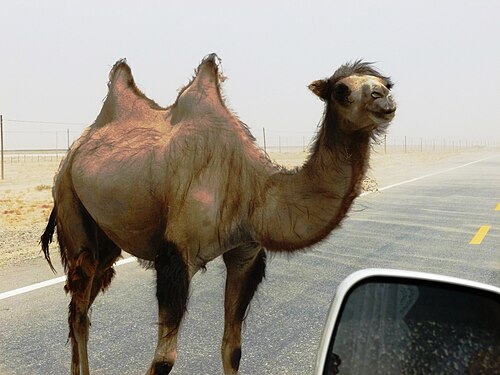
Wild Bactrian camel on road east of Yarkand

Group in Ömnögovi Province, Mongolia

Wild Bactrian camels in the Gobi desert

Wild Bactrian camel on an Uzbek stamp