Cameo (carving)
Videos
Cameo is a method of carving an object such as an engraved gem, item of jewellery or vessel. It nearly always features a raised relief image; contrast with intaglio, which has a negative image. Origin
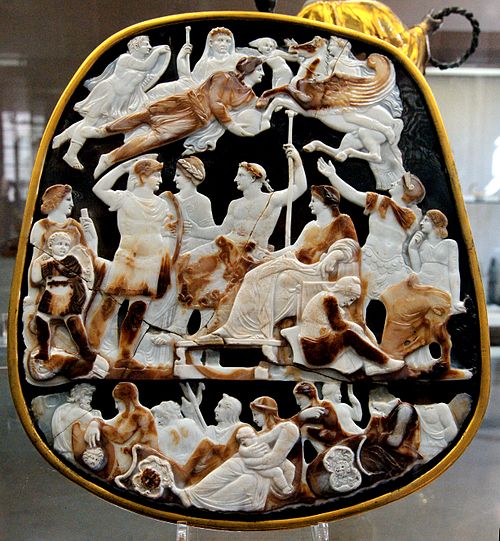
The Great Cameo of France, five layers sardonyx, Rome, c. 23 AD, the largest of Antiquity

Eagle Cameo, Roman 27 B.C. Two-layered onyx.

Cameo of Roman Emperor Augustus wearing a gorgoneion and a sword-belt. Three-layered sardonyx cameo, Roman artwork, c. 14–20 AD.

Perfume bottle made of cameo glass found in the Roman necropolis of Ostippo (Spain). On side B shown above, two males are on a bed in an erotic scene. Side A of the bottle, not shown, shows a female and a male in an erotic scene. 25 BCE – 14 CE
Great Cameo of France
Videos
The Great Cameo of France is a five-layered sardonyx Imperial Roman cameo of either about 23 AD, or 50–54 AD. It is 31 cm by 26.5 cm. It is now in the Bibliothèque Nationale in Paris.
Cameo (carving)
…from this period are the Gemma Augustea, the Gemma Claudia made for the Emperor Claudius, and the largest flat engraved gem known from antiquity, the Great Cameo of France. Roman cameos became less common around in the years leading up to 300 AD, although production continued at a much reduced rate right through the Middle…

The Great Cameo of France