Campus Martius
Videos
The Campus Martius was a publicly owned area of ancient Rome about 2 square kilometres in extent. In the Middle Ages, it was the most populous area of Rome. The IV rione of Rome, Campo Marzio, which c
Model of the ancient Campus Martius, seen near the lower left of the picture, around AD 300. When the Assembly of the Centuries used to vote on the Field of Mars in the Roman Old Republic, it had been an area outside the Pomerium, the exact boundaries of which have not been preserved. By this time, however, it was a perfectly rectangular field, surrounded by buildings very much inside the city proper.


The Pantheon and the Fontana del Pantheon, a landmark of the Campus Martius since ancient Rome
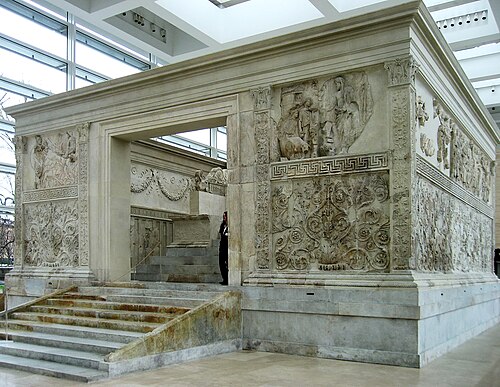
Ara Pacis Augustae, the "Altar of Augustan Peace", as reassembled

View of the opposite side Tellus Panel at the left and Roma Panel at the right
Sulla
Videos
Lucius Cornelius Sulla Felix, commonly known as Sulla, was a Roman general and statesman of the late Roman Republic. He came to prominence for his military exploits and was the first general during th
Campus Martius
…projects. Besides temples and wooden markets, entertainment venues were built as well, though they were to be temporary. Starting in the time of Sulla, building lots were sold or granted to influential Romans, and insulae (apartment blocks) and villas encroached on the common land. It later became the…

Portrait of Sulla on a denarius minted in 54 BC by his grandson Pompeius Rufus

Denarius minted by Sulla's son Faustus in 56 BC. It features the head of Diana on the obverse and the Bocchus monument on the reverse, showing the moment of the capture of Jugurtha. The reverse was also a reproduction of Sulla's first signet ring.

Depiction of Marius as victor over the invading Cimbri.

"Sulla", a copy (probably from the time of Augustus) after a portrait of an important Roman from the second century BC, with similarities to "Marius", suggesting that both statues were conceived and exhibited together as either siblings or rivals; Munich, Glyptothek.