Canister shot is a kind of anti-personnel artillery ammunition. Canister shot has been used since the advent of gunpowder-firing artillery in Western armies. However, canister shot saw particularly frequent use on land and at sea in the various wars of the 18th and 19th century. Canister is still used today in modern artillery.
Artillery shot-canister for a 12-pounder cannon from the US Civil War era. From the collection of the Minnesota Historical Society. Note the uniform, regularly shaped projectiles, unlike langrage.
British case-shot, 1914
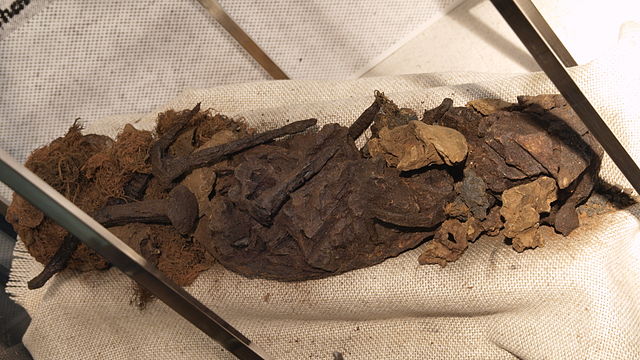
Langrage shot for a cannon of the early 17th century, consisting of iron nails, iron fragments, loam and hemp fabric, as a substitute for spherical metal projectiles.
The M1 Abrams is a third-generation American main battle tank designed by Chrysler Defense and named for General Creighton Abrams. Conceived for modern armored ground warfare, it is one of the heaviest tanks in service at nearly 73.6 short tons. It introduced several modern technologies to United States armored forces, including a multifuel turbine engine, sophisticated Chobham composite armor, a computer fire control system, separate ammunition storage in a blowout compartment, and NBC protection for crew safety. Initial models of the M1 were armed with a 105 mm M68 gun, while later variants feature a license-produced Rheinmetall 120 mm L/44 designated M256.
U.S. Army M1A2 Abrams with production TUSK explosive reactive armor package installed in Iraq, 2008
General Motors XM1 prototype
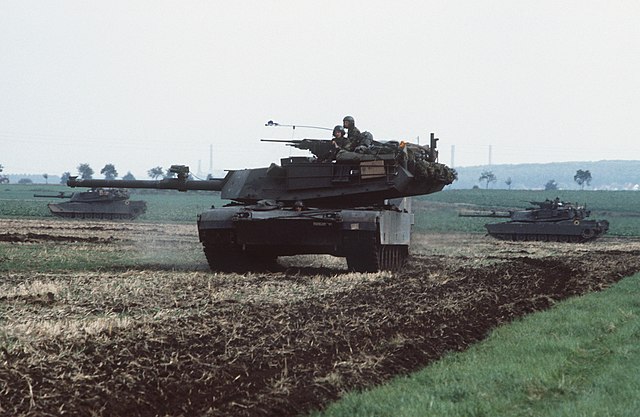
M1 Abrams 105 mm main battle tanks maneuver into firing positions during Exercise REFORGER '85.
Early production vehicle in 1983