Capetian–Plantagenet rivalry
Videos
The Capetian–Plantagenet rivalry was a series of conflicts and disputes that covered a period of 100 years (1159–1259) during which the House of Capet, rulers of the Kingdom of France, fought the House of Plantagenet, rulers of the Kingdom of England, over the Plantagenet-held Angevin Empire which at its peak covered around half of the territory within France. Some historians refer to this series of events as the "First Hundred Years' War".


Richard the Lionheart prisoner (left) and mortally wounded at Chalus (right) (Effigies Regum Angliae, 14th century)

The Battle of Gisors, 1198, between Philip II Augustus (left) and Richard the Lionheart (right) (Chroniques de Saint-Denis (ou de France), 14th century)

Philip Augustus crossing the Loire (Grandes Chroniques de France, 14th – 15th century)
The historical ties between France and the United Kingdom, and the countries preceding them, are long and complex, including conquest, wars, and alliances at various points in history. The Roman era saw both areas largely conquered by Rome, whose fortifications largely remain in both countries to this day. The Norman conquest of England in 1066 decisively shaped the English language and led to early conflict between the two nations.


Henry VIII and Francis I met at the Field of the Cloth of Gold in 1519, briefly marking a period of détente between the two nations
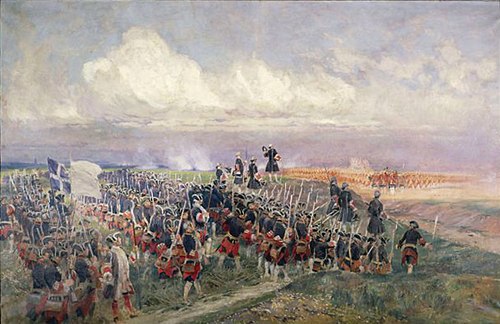
The War of the Austrian Succession was one of several wars in which states tried to maintain the European balance of power.

The loss of Quebec to the British in 1759 was a major blow to French colonial ambitions, compounded by defeats in Europe and India.