Carnivora
Videos
Carnivora is an order of placental mammals specialised primarily in eating flesh, whose members are formally referred to as carnivorans. The order Carnivora is the sixth largest order of mammals, comp
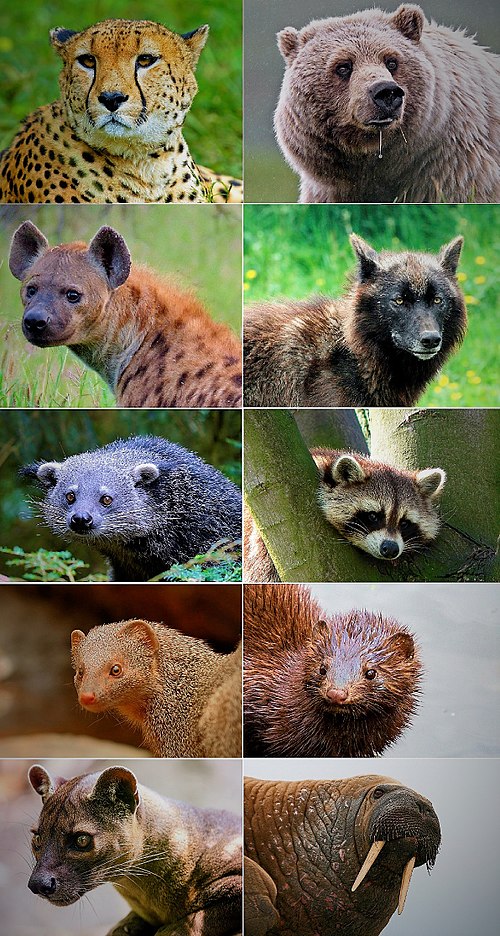
Carnivora portraits

Life reconstruction of Tapocyon robustus, a species of miacid

Skull of a fossa (Cryptoprocta ferox). Note the large and conical canine and carnassial teeth common in feliforms.

A black-backed jackal (Lupulella mesomelas) trying to predate on a brown fur seal (Arctocephalus pusillus) pup. These two species illustrate the diversity in bodyplan seen among carnivorans, especially between pinnipeds and their terrestrial relatives.
Feliformia
Videos
Feliformia is a suborder within the order Carnivora consisting of "cat-like" carnivorans, including cats, hyenas, mongooses, viverrids, and related taxa. Feliformia stands in contrast to the other sub
Carnivora
…and the open seas. Carnivorans exhibit a wide array of body plans, varying greatly in size and shape. Carnivora are divided into two suborders, the Feliformia, containing the true felids and several "cat-like" animals; and the Caniformia, containing the true canids and many "dog-like" animals. The feliforms…

Suborder feliformia

Feliformia skull showing double-chambered bullae

Fossa (Cryptoprocta ferox)

Cheetah (Acinonyx jubatus)