Carolingian art
Videos
Carolingian art comes from the Frankish Empire in the period of roughly 120 years from about 780 to 900—during the reign of Charlemagne and his immediate heirs—popularly known as the Carolingian Renai
Aachen Gospels, early 9th century, church treasury of Charlemagne's Palatine Chapel, now Aachen Cathedral, Aachen, Germany


The Lothair Crystal, engraved rock crystal, mid-9th century

Ivory plaque, probably from a book cover, Reims late 9th century, with two scenes from the life of Saint Remy and the Baptism of Clovis

Drogo Sacramentary, c. 850: a historiated initial 'C' contains the Ascension of Christ. The text is in gold ink. (Bibliothèque nationale de France)
Medieval art
Videos
The medieval art of the Western world covers a vast scope of time and place, with over 1000 years of art in Europe, and at certain periods in Western Asia and Northern Africa. It includes major art mo
Carolingian art
…human figure, and setting the stage for the rise of Romanesque art and eventually Gothic art in the West. The Carolingian era is part of the period in medieval art sometimes called the "Pre-Romanesque". After a rather chaotic interval following the Carolingian period, the new Ottonian dynasty revived Imperial art…
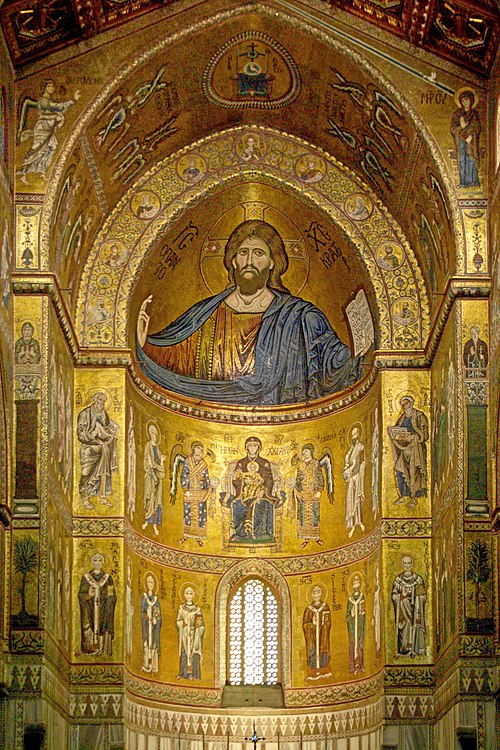
Byzantine Church mosaics, Monreale, Sicily, late 12th century

Detail of The Effects of Good Government, a fresco in the City Hall of Siena by Ambrogio Lorenzetti, 1338.
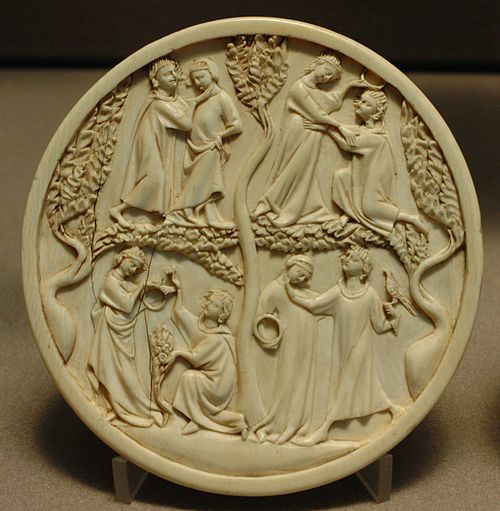
Scenes of courtly love on a lady's ivory mirror-case. Paris, 1300–1330.

The jewelled cover of the Codex Aureus of St. Emmeram, c. 870, a Carolingian Gospel book.